He Out-Cornered Me in His Own Car. I Still Won by 1.177 Seconds.
Oct 5, 2026
Six days after Smurfette found the tire wall, it was time to get back on the horse. A Mustang, naturally. (The Road Atlanta T7 crash gets its own post later.)
AI-coached track weekends · Circuit of the Americas, October 2026. In July I wrote that Austin was going to settle something. One car, two drivers, and the only column of the spreadsheet the driver owns.
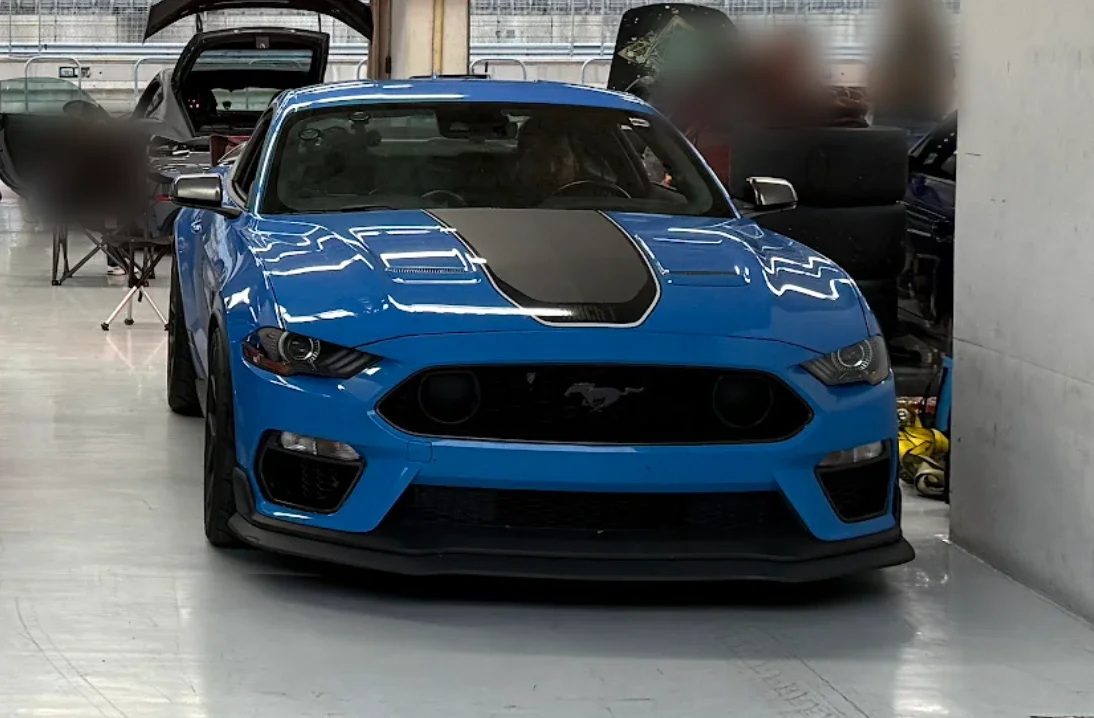
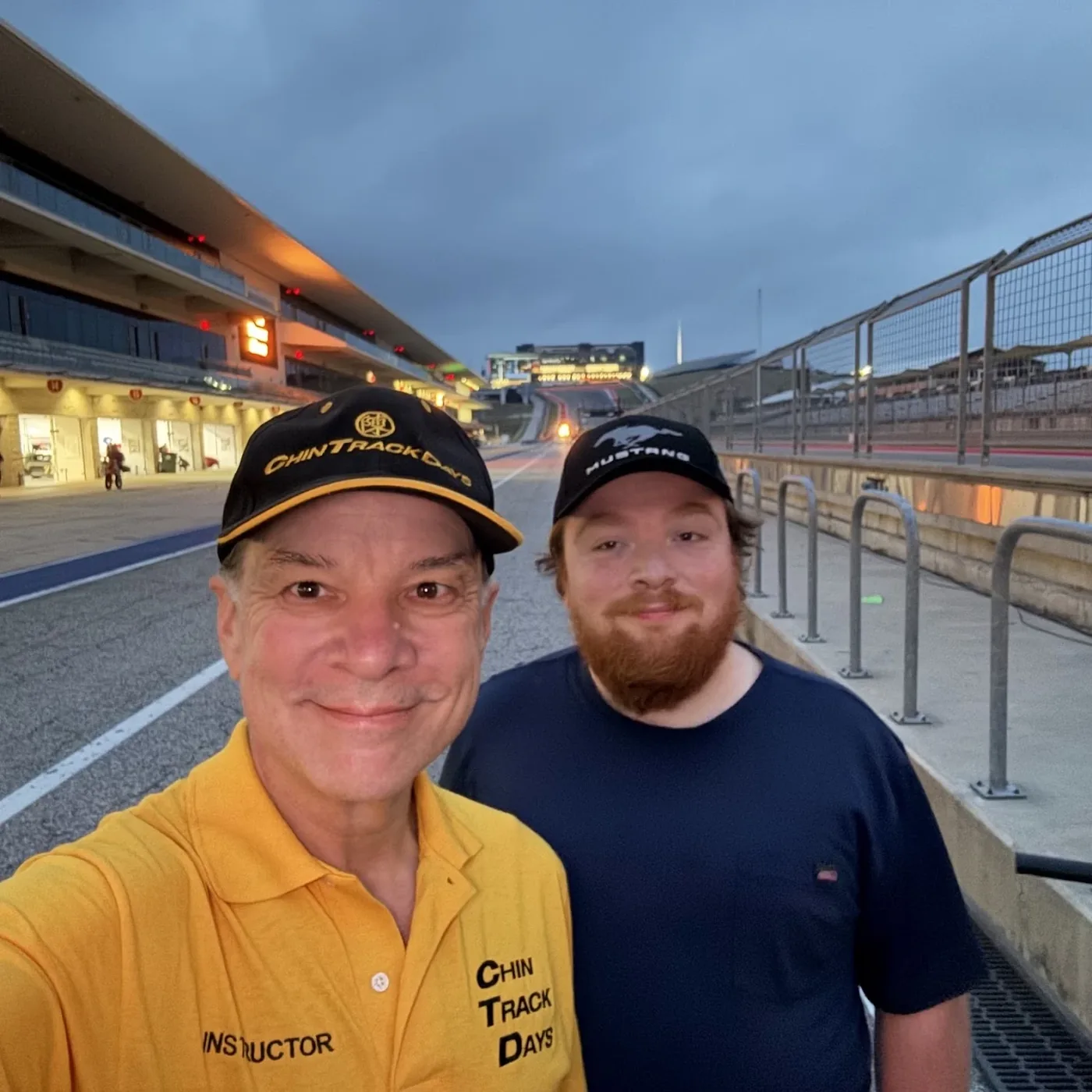 Saturday, before the first session. The instructor shirt is for my students. The car is Zach's.
On October 3 and 4, my son Zach and I took his 2022 Mustang Mach 1 to COTA with Chin Track Days. One car, a six-speed manual, two drivers taking turns all day Saturday. The car didn't change. What changed between sessions was who was driving, the time of day, and a little of the weather.
That's about as clean a comparison as I can run on myself. So of course I ran it.
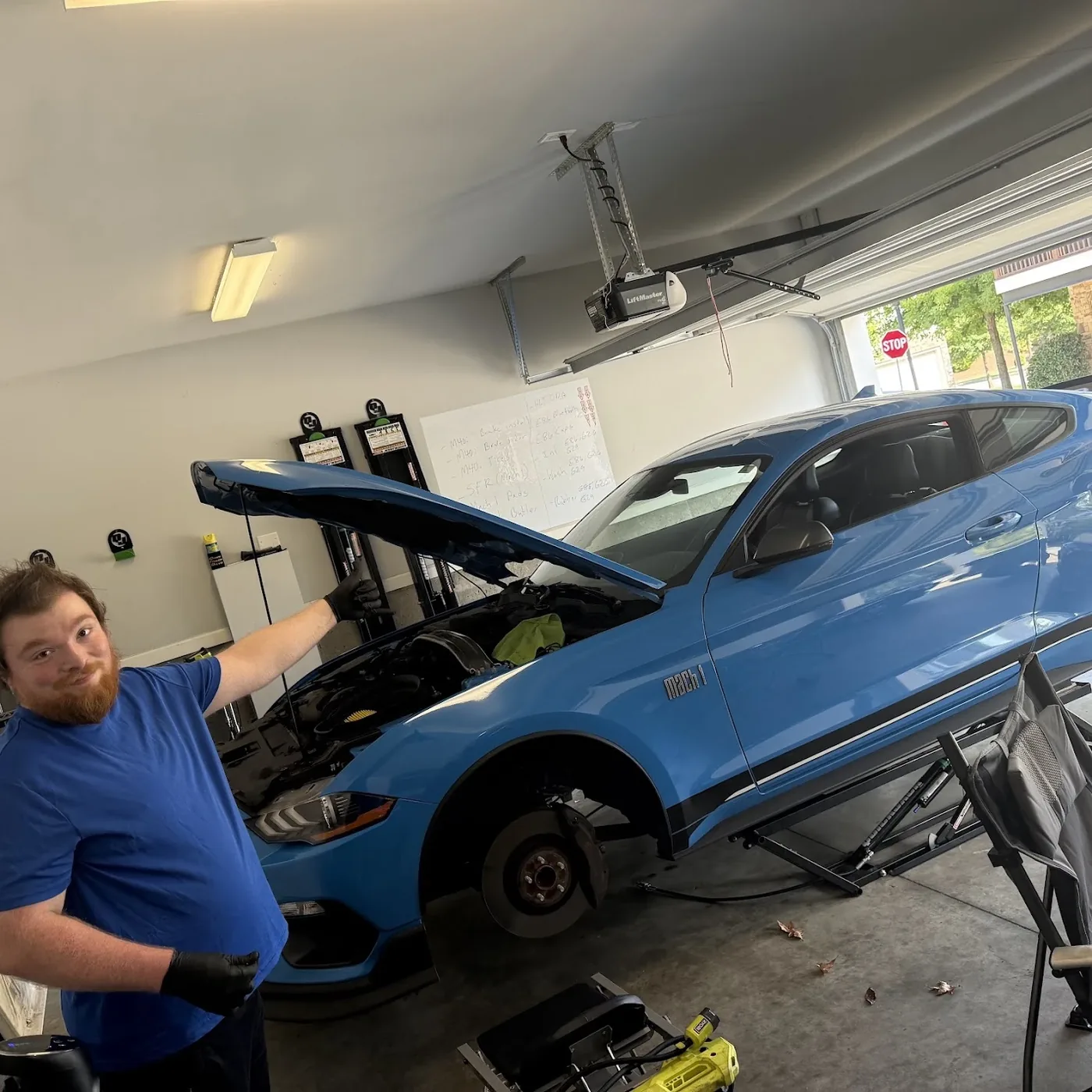 Zach's car, my garage, Zach's prep.
Zach's morning
Zach's day started at 7:59 with the orientation session: 30 minutes under a full-course yellow, no passing, and a slow pace for everyone by design. It's a familiarisation run, not a timed session, so I've left it out of every comparison below.
By 11:40, in his second real session, he ran a 2:39.98, and it stood as his best lap of the day. For most of Saturday, he was the faster driver in his own car.
Here's how the day went, one car, the two of us swapping seats:
| Session | Driver | Best lap |
|---|---|---|
| 9:50 am | Zach | 2:43.97 |
| 11:02 am | Me | 2:45.14 |
| 11:30 am | Zach | 2:39.98 |
| 1:31 pm | Me | 2:43.93 |
| 2:02 pm | Zach | 2:43.53 |
| 3:01 pm | Me | 2:38.87 |
| 3:33 pm | Zach | 2:43.20 |
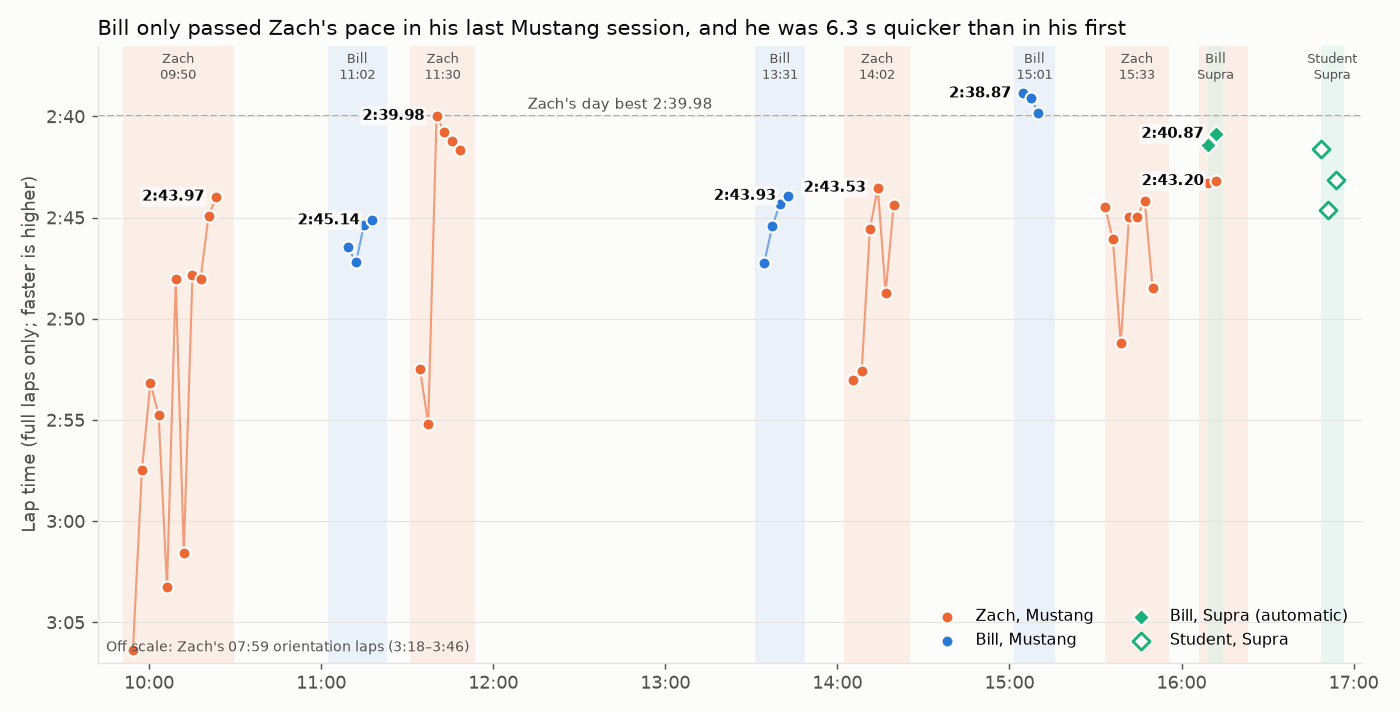 Every full lap Saturday, by clock time. Orange is Zach, blue is me, green is the Supra at the end of the day. Higher is faster.
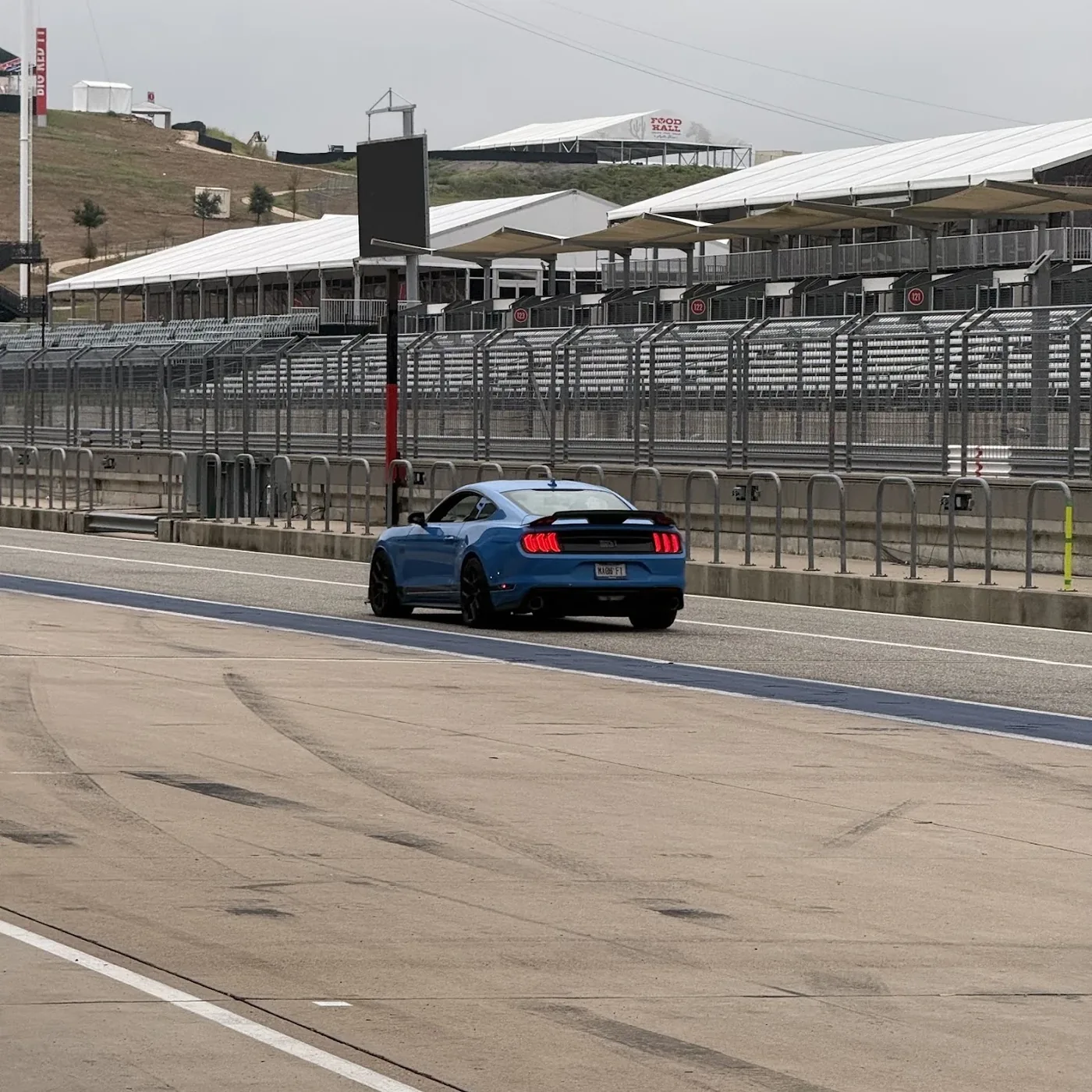
My morning in Zach's car
Here's how it felt from the driver's seat:
It took me longer to get up to speed in Zach's car. Two reasons: first, it's his car. He is much more used to driving this car and driving a stick every day. I am coming from the Z4 and M440i, MUCH different cars on track, especially the auto. My morning laps were spent thinking about shifting. After the accident in the Z4 last Sunday, my mind was also about not wrecking my son's car. I was not committed to the grip of his car, especially in the esses. It took me all day to build up my muscle memory with rev matching and no-lift shifts, as well as confidence in the car and myself.
Then I asked the data what that hesitation actually cost. Over the day, my median lap went from 2:45.92 in the 11:02 session to 2:39.10 in the 3:01 session. That's 6.8 seconds. Here's where it came from.
The shifting was real, and it got fixed over lunch. You can see an upshift in the GPS as a short gap in the car's acceleration while the clutch is in. In the morning my median gap was 0.51 seconds, and a quarter of my upshifts took longer than 0.7. The longest was 1.37 seconds. I lifted on nearly every one; the throttle data shows one no-lift shift in 23. Zach kept his foot in on about one in six of his.
After lunch it was a different driver. From my first flying lap at 1:34, every lap's median was 0.28 to 0.35 seconds, and it stayed there. Once he was past orientation, Zach was at 0.50 to 0.58. So by the afternoon I was shifting quicker than the guy who drives the car every day. It didn't take all day. It took one lunch.
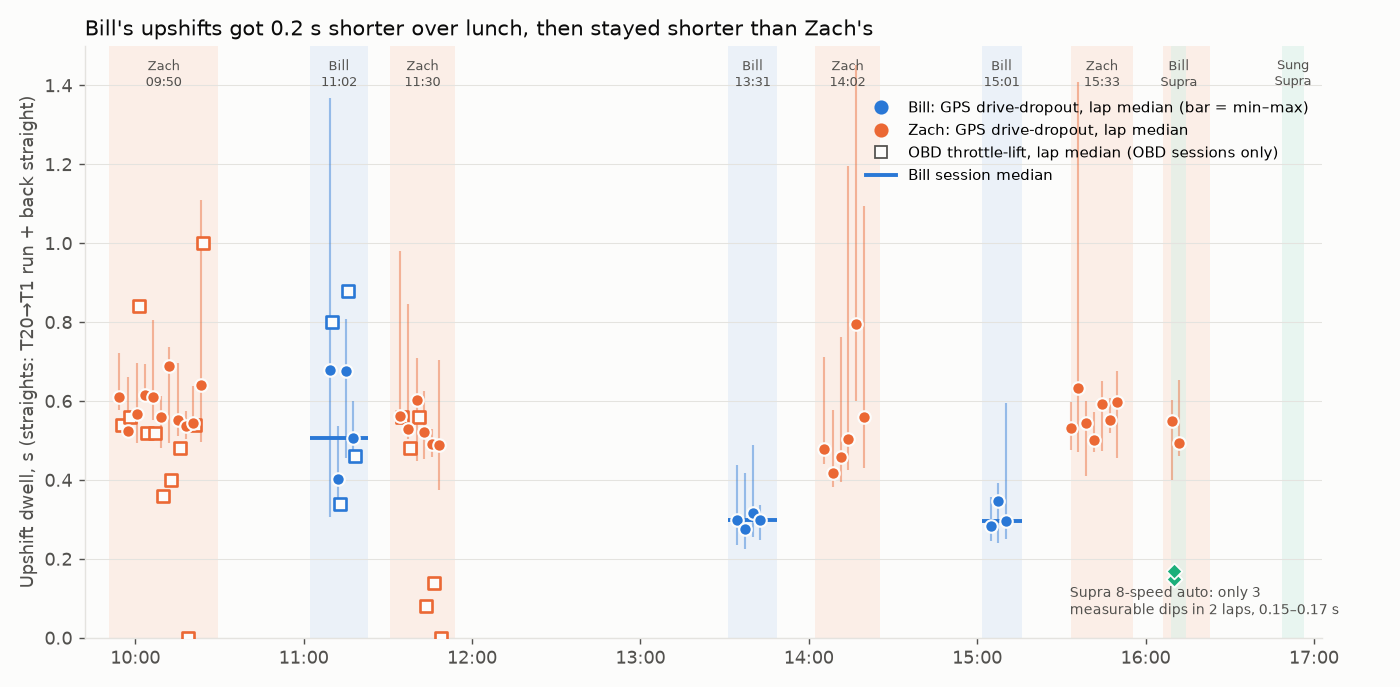 Time without drive on each upshift, lap by lap. My morning (blue, 11:02) has the long tail. From 1:31 on it's a tight band around 0.3 seconds.
Rev matching was mostly there from the start. I blipped 17 of 23 downshifts in the morning, about Zach's rate. The exception was T12, the big stop at the end of the back straight, where I only blipped 2 of 6. The OBD dongle dropped off after about 11:50, so I can't see what happened to that in the afternoon.
Commitment grew where I said it would. Over the T3 crest, the fast entry to the esses, I averaged 87 mph in the morning. In the last session it was 93, about 3 mph over Zach.
But the esses weren't where the time was. T3 through T7 gave me 0.86 seconds of the 6.8. That's 13 percent. The apex speeds at T4, T5 and T6 were near Zach's from the morning. The one real gap in there, the run from T5 to T6, where Zach accelerates to about 72 mph and I sat at 66 to 67, never closed. It still cost me about 0.18 seconds in my last session.
Most of the 6.8 seconds, 3.6 of it, came from getting off corners and down straights. T11 and the back straight, 1.11 seconds. T16 through T18, 0.94. T19, 0.71. T20 and the front straight, 0.80. Those are the shift-heavy, drive-out parts of the lap. That's where shifting and confidence show up on a stopwatch.
And T12 late braking was there from my first flying lap. On my first flying lap I braked 850 ft before the T12 apex. My median that morning was 864 ft, and my last session was 860. That's about 170 ft later than Zach's median all day. What improved at T12 was the speed I arrived with and the speed I left with: 3.1 mph more at the end of the back straight, 3.9 mph more on the exit.
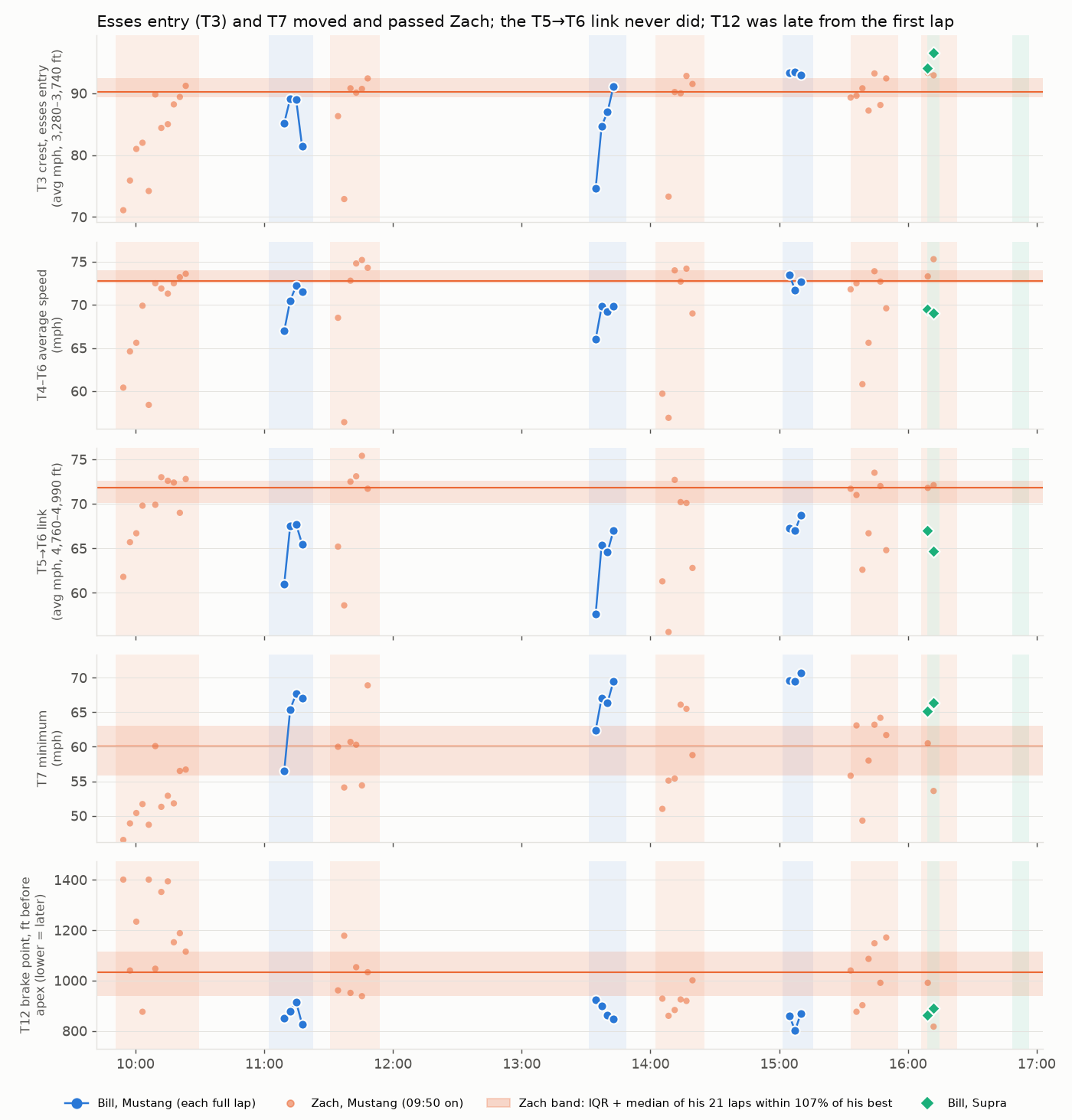 The T3 entry and T7 moved and passed Zach's band. The T5 to T6 link never did. The T12 brake point (bottom) was late from the first lap.
So my account was half right. The shifting cost real time and got fixed. The confidence was real and it built all day. But the hesitation I felt most, in the esses, was the cheapest part. What it cost was mostly on the way out of corners, not in them.
One honest caveat: Zach was 3.2 to 3.6 seconds slower in both of his afternoon sessions than he was at 11:40, so some of my flat early afternoon may be conditions, not me. But conditions don't explain my 2:38.87. Zach went out right after me, at 3:33, in the same 77°F, and his best was a 2:43.20.
The race: best vs best
My 2:38.87 against Zach's 2:39.98. Lined up on distance and timed from the real start/finish line, it's 2:38.788 against 2:39.965. I win by 1.177 seconds. (The timer says 1.11. The box at the bottom explains the difference.)
My 2:38.87, Saturday afternoon in Zach's Mach 1. This is the lap in the race below.
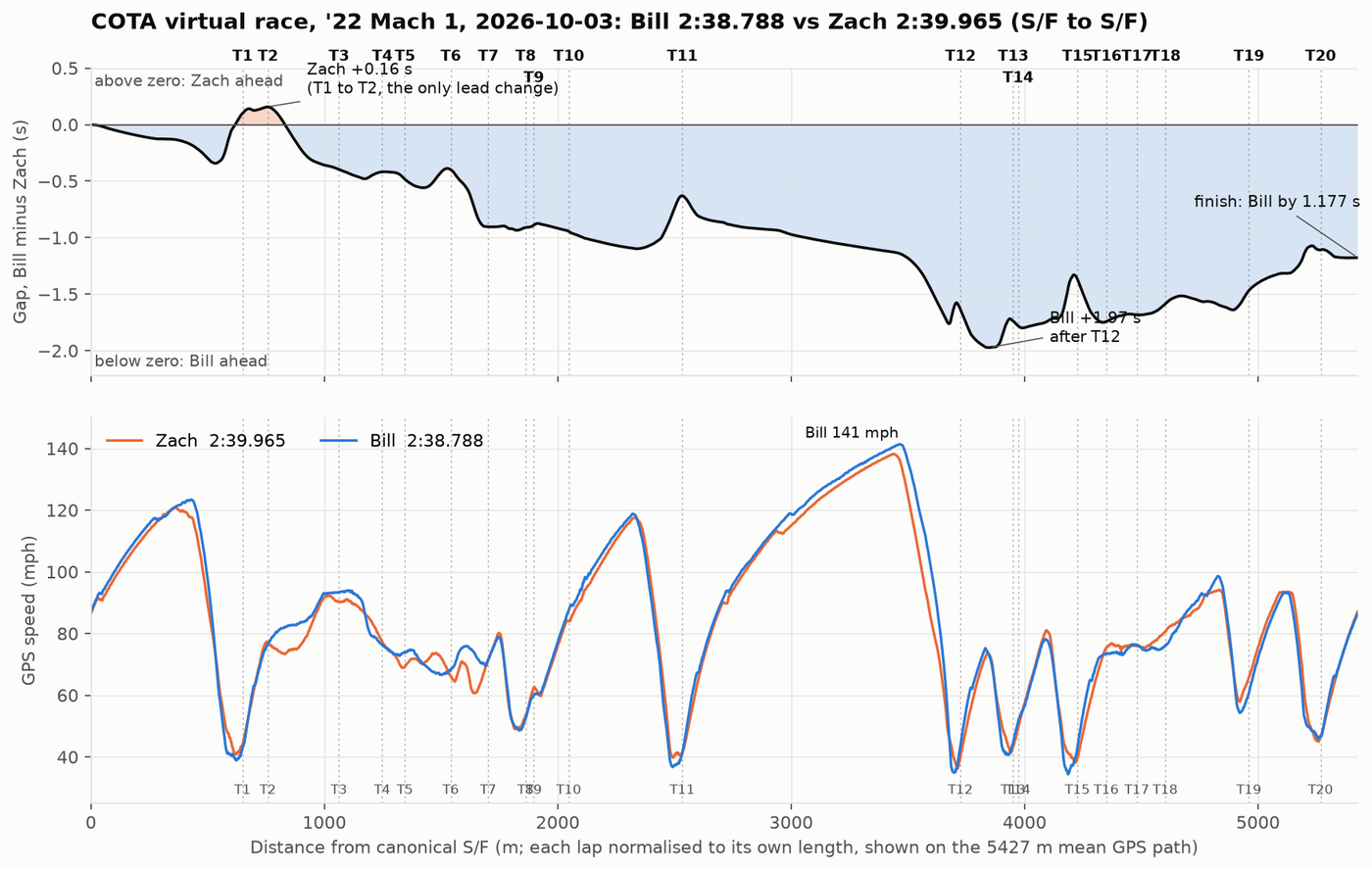 Top: the running gap. Below zero, I'm ahead. Bottom: both speed traces.
Up the hill to Turn 1. We cross the line at 87 mph, within a mph of each other. Up the 87 ft climb I'm 2 mph quicker. We brake in almost the same place, but I brake harder over the blind crest, 1.27 g to 1.02.
Zach strikes back at the apex. He carries 40.6 mph through T1 to my 38.9 and goes ahead by up to 0.16 seconds. It's the only time he leads all lap.
Down the hill, T2. The road falls away off the back of T1. I run 81 to 84 mph down there. Zach's throttle sits at 27 to 46 percent and he runs 73.5 to 76.5. I'm 7.9 mph faster on the exit and back in front. T2 is worth 0.37 seconds.
T7. Zach brakes for it and drops to 60.7 mph. I only lift and keep 69.5. That's 0.30 seconds.
T11, the hairpin. Zach is better on the way in. He brakes later and carries 39.7 mph through the apex to my 36.7. He takes back 0.47 seconds in about 600 ft. But I drive off it harder, and by the end of the back straight I'm doing 141.4 mph to his 138.2.
T12, the corner that decided it. I arrive at 141.1 mph to his 137.2. Zach starts braking 879 ft before the apex. I start about 60 ft later, and I brake harder: 1.20 g to his 0.97. Zach's OBD shows two throttle blips for his downshifts, at 85 and 68 percent, and while he blips his deceleration sags to about 0.55 g. I hold 0.87 to 0.98 g through that same stretch. He carries 1.3 mph more through the slowest point, but I'm back on the power first and leave at 73.9 mph to his 70.9.
T12 alone: 0.85 seconds. That's 72 percent of the whole margin, in one braking zone. My lead peaks at 1.97 seconds just after it.
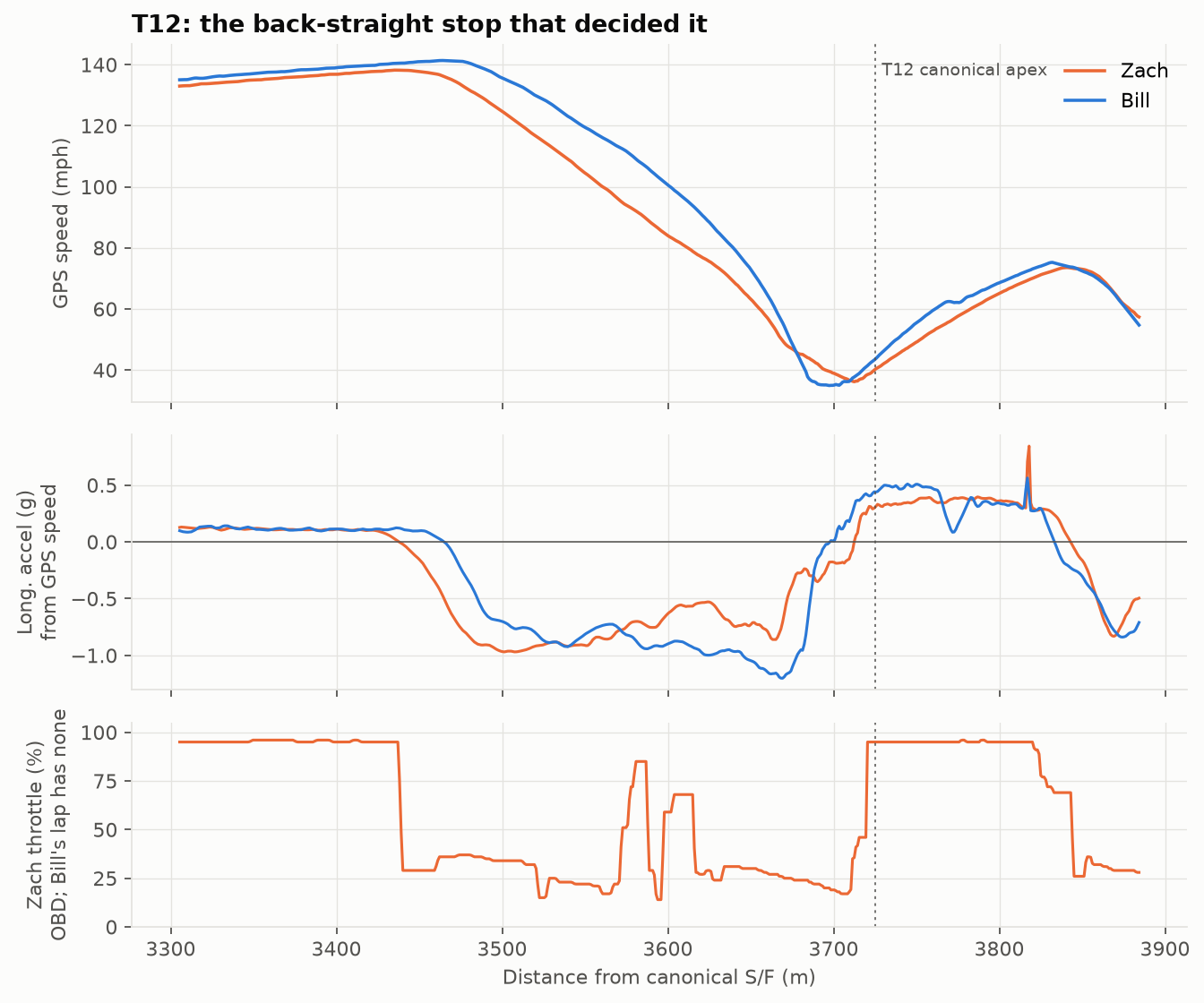 T12. Top: speed. Middle: deceleration from GPS. Bottom: Zach's throttle, with the two downshift blips. My lap has no OBD.
The stadium and the run home belong to Zach. He carries more speed through T13 to T15, 38.1 mph at T15 to my 34.4. At T19 he carries 57.9 to my 54.2. At T20 he brakes later and harder, 1.29 g to my 1.08. From T13 to the line he takes back 0.80 seconds.
It isn't enough. I cross the line 1.177 seconds ahead.
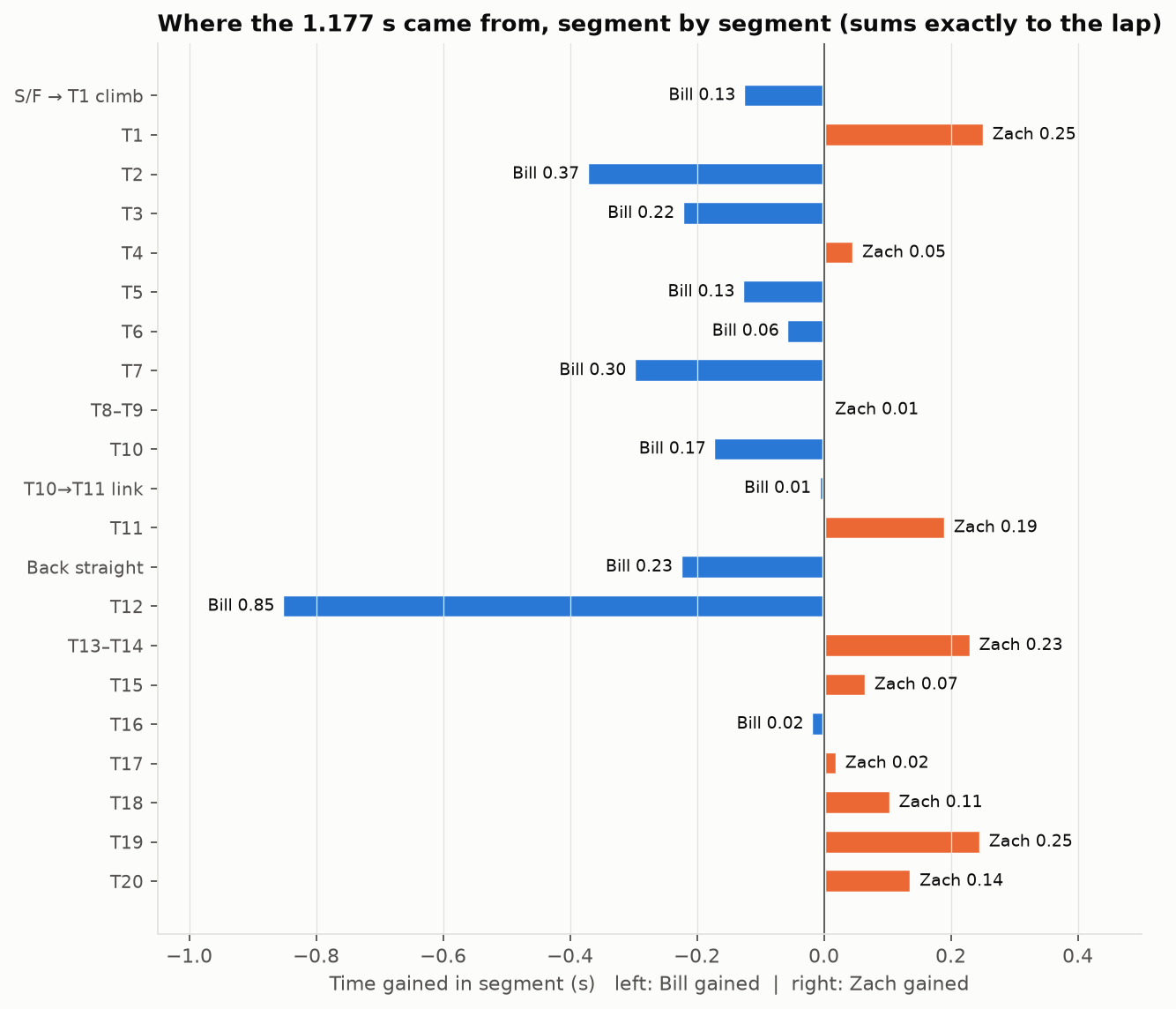 Where the 1.177 seconds came from. Left is me, right is Zach. They add up exactly to the lap.
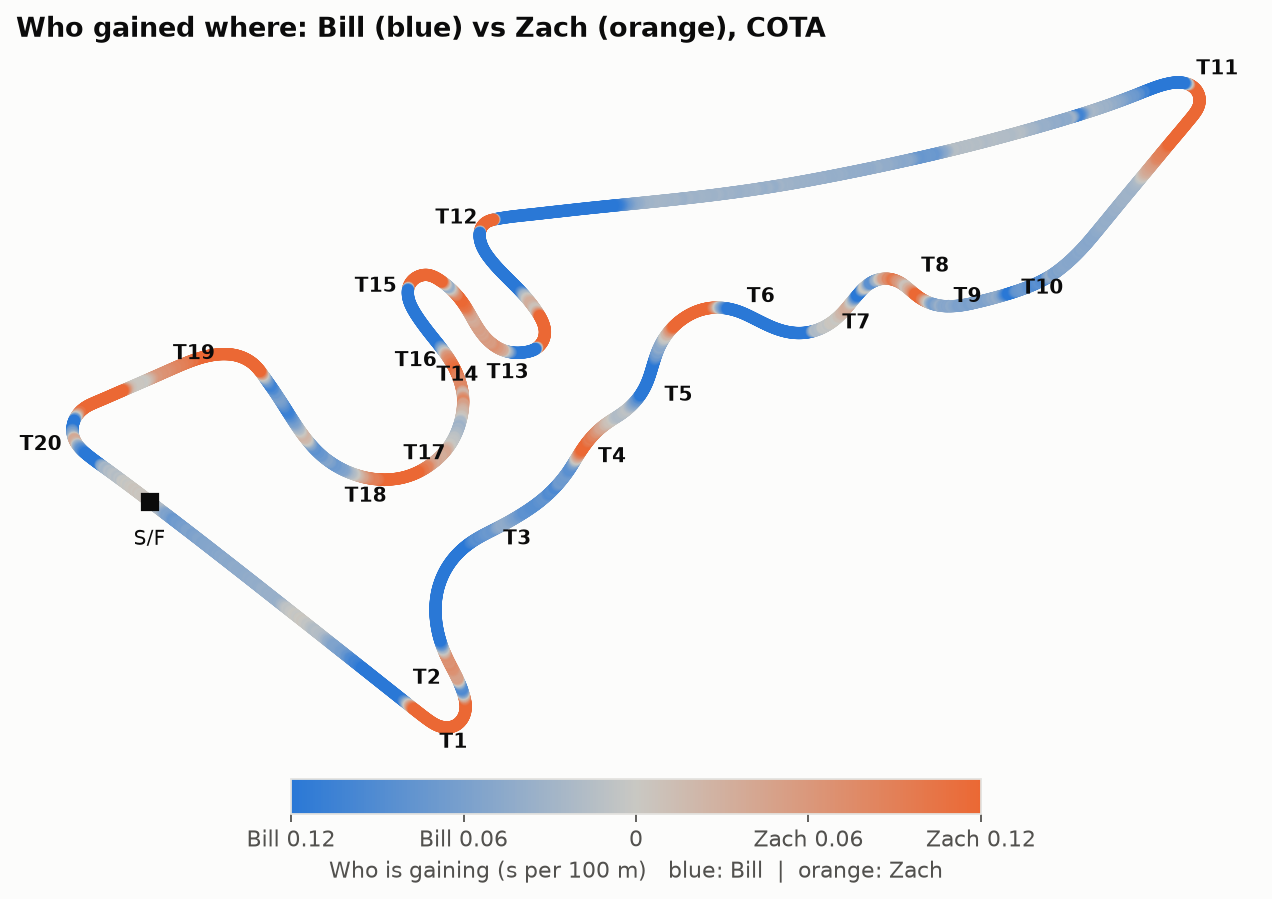 Blue where I was gaining, orange where Zach was.
Look at the pattern, not the total. Of the eight heavy-braking corners, Zach carried more minimum speed through seven: T1, T11, the stadium corners, T19. I brake later and harder in a straight line, carry less through the middle, and get on the power sooner. My way paid off on the long straights. His way won the slow corners.
What we've each shown: theoretical vs theoretical
A best lap is one lap. Over a day, each of us drove pieces of a faster one. So the next question is: if you stitch together the best pieces each of us has already driven, who's faster?
Using our connected-sections method, which only joins pieces where the speed carried from one into the next actually matches:
- My theoretical lap: 2:38.27. That's 0.60 seconds under my real best.
- Zach's theoretical lap: 2:39.00. That's 0.98 under his.
- I win by 0.72 seconds.
Zach left more on the table than I did, so the gap narrows. It doesn't close. I tried every reasonable way of cutting the lap into sections, and the gap moves between 0.26 and 1.12 seconds. I'm ahead every time. One caveat: with Zach's extra laps, the cut at T5 no longer passes our own test for him. Merge T5 to T7 into the first section and I win by 0.97.
Zach has already shown some of the things that would close it. He's taken T7 at 68.9 mph once, against his usual 60. And on his last flying lap of the day, at 4:12, he braked for T12 about 45 ft later than my median, from 141 mph. He's done the brake point. He just hasn't done it on his fastest laps: that one was a 2:43.20.
The style difference holds up across all our laps, not just the two bests. Zach carries more minimum speed at T1, T11 and T15. I brake later at T12 and carry more through T7. Zach is more repeatable through T1 to T7. I'm more repeatable from T8 to T14. Across the 20 of his laps that reached T12 at full speed, his brake point moved about 370 ft. Across all 11 of mine, it moved about 120.
Now the twist. The common way to build a theoretical lap is to take your fastest time through each corner and add them up. Do that with all 20 corners and you get me at 2:37.32 and Zach at 2:36.95. Zach wins by 0.36 seconds (and by about a second if you cut the corners at slightly different points, which tells you how fragile this method is).
That isn't Zach being faster. It's sample size. Zach had 32 full laps Saturday outside orientation to pick his best corners from, 21 of them within 7 percent of his best. I had 11. Take the fastest slice of 32 laps and you'll find more lucky slices than in 11. And a per-corner stitch doesn't care whether the speed you left one corner with matches the speed you arrived at the next. The connected sections do, and they put me back in front.
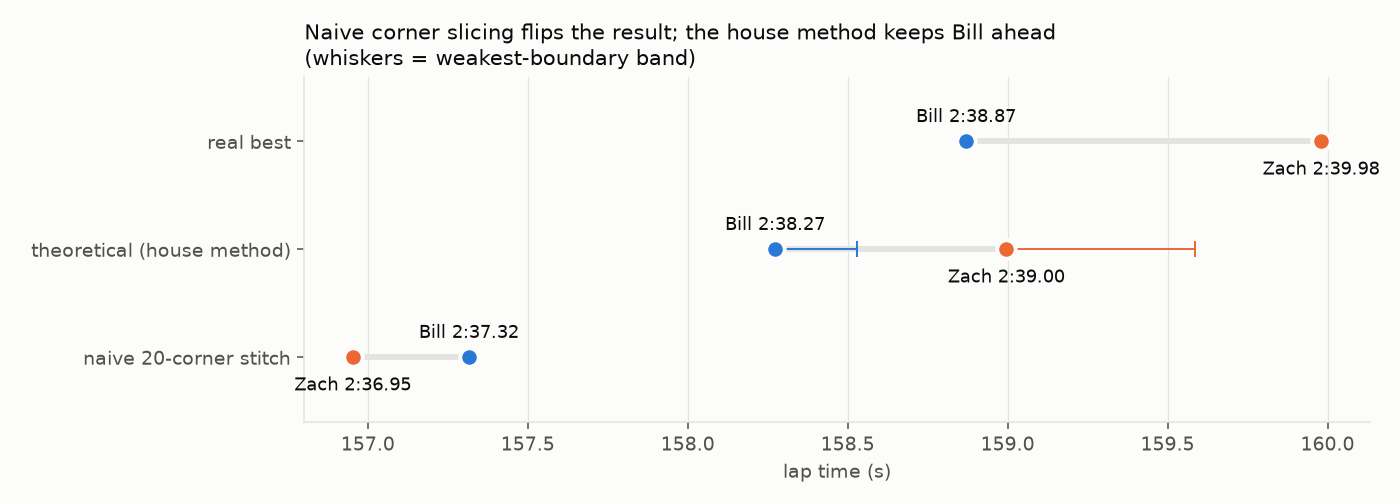 Real bests, connected-section theoretical laps, and the naive 20-corner stitch. The naive method flips the result.
Sunday: dry, then rain
Sunday morning was dry, and then the rain came. Zach's 8:03 session was orientation again, under a full-course yellow, so its lap times say nothing about the track. By his 9:51 session he was running at full pace. He ran a 2:40.19, just 0.21 seconds off his Saturday best, and hit 138 mph on the back straight.
Then the rain came back. His next lap was a 2:45.05. On the lap after that, at 10:04, the car let go at T10.
Zach at 10:04 Sunday, with the wipers on. He passes a car on the left on the climb at 0:27, goes into T10 at 83 mph at 0:28, the car steps out at 0:31, and it's off the right side of the track at 0:34. He's back on the track by 0:55.
The data shows what happened. He went into T10 at 83 mph, close to his dry speed. T10 is a fast left over the top of the hill. It's banked the right way, but the road falls away at 6 to 7 percent just where the corner tightens. Through that stretch he was pulling 0.95 g sideways and his speed dropped from 80 to 65 mph. On his dry laps it was still climbing there. At the exit the car pointed about 15 degrees further left than his normal line. Then it snapped back the other way. In about two seconds the sideways load swung from 0.98 g left to 1.05 g right, and the car left the right side of the track at 41 mph. It ran out to about 45 feet right of the usual line through there. On his dry laps he never got more than 11 feet from it.
He didn't spin it and he didn't hit anything. The car stayed pointed down the track and slowed to 1 mph on the grass, about 600 feet past the corner. Then he drove it back on. That T10 cost him about 20 seconds against the lap before, and he pitted at the end of the lap.
I'd gone out once at 9:17, a quick check while it was still dry: a single lap out and back in, and the car still touched 141 mph on the back straight. My real session started at 1:30, in the rain. I did six full laps, and each one was faster than the last:
| Lap | 2 | 3 | 4 | 5 | 6 | 7 |
|---|---|---|---|---|---|---|
| Time | 3:22.96 | 3:20.43 | 3:18.23 | 3:17.41 | 3:13.34 | 3:11.15 |
The track was drying as I went. My top speed climbed from about 114 to 130 mph, against about 142 dry. My best was 32 seconds off Saturday. At the same point in T10 I was doing 62 to 68 mph, hours after Zach's moment and in different rain.
Zach went out right after me, at 2:02, and ran a 3:01.12, ten seconds quicker than my best. In his last session, at 3:31, he got down to 2:53.58. His Sunday file just took a day to reach the garage.
The Supra at COTA
If Smurfette is totaled (TBD), is there a Supra in my future? Smurfette 3.0? Manual?
At the end of Saturday my student asked me to take his 2023 Supra 3.0 Auto out. My first time in it, but it's basically the same car as my Z4 M40i, so I know the chassis well. As instructors we often drive our students' cars, but only when they ask, never because we want to.
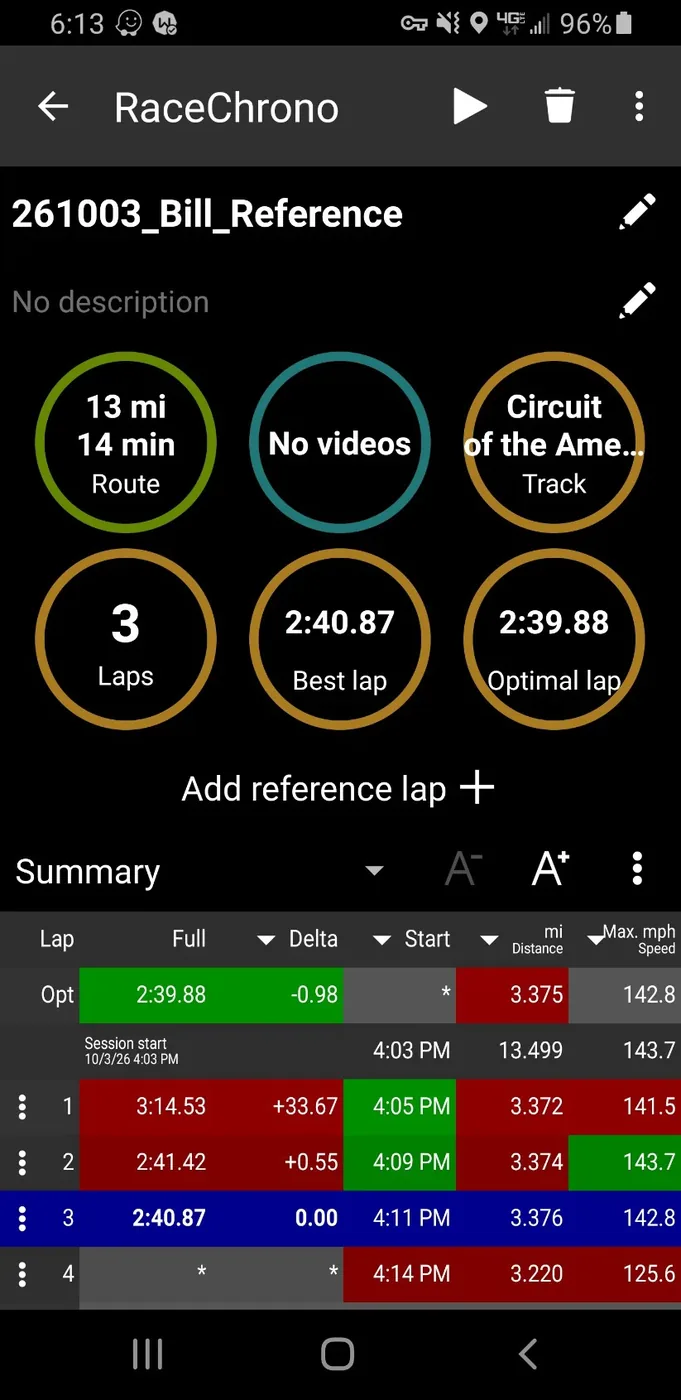 My Supra session in RaceChrono. Best 2:40.87, "optimal" 2:39.88.
My two full laps were 2:41.42 and 2:40.87. My lap time wasn't the point. Before I drove his car, my student's best was a 2:43. I drove it to show him the lines and the braking points, and about 30 minutes after I pitted, on his own in the happy-hour session, he ran a 2:41.62. He finished the weekend with a 2:38.12. In a car with nothing to shift, my second full lap was within 2.0 seconds of my Mach 1 best.
The automatic shows up in the data. In two laps there were only 3 measurable drive gaps, 0.15 to 0.17 seconds each. The Mach 1 in my last session had five a lap at 0.30. My habits came along too: 95.2 mph over the T3 crest, my highest of the day, and the same T12 brake point as in the Mustang, 876 ft. Where the Supra was slower was T4 to T6, 69.2 mph average against 72.7 in the Mach 1. My student's time through there was the same as mine, so that's the car, not either of us.
It's not a clean comparison. By then I had three COTA sessions behind me. And RaceChrono's 2:39.88 "optimal" is the same kind of per-corner stitch I just warned you about, so I'll hold it loosely.
What I'm taking home
Zach out-cornered me in his own car. He carries more speed through the slow corners than I do, and he's more consistent through the first part of the lap. I beat him by a second, and 72 percent of that second was one braking zone.
He's already shown the T12 brake point. Next time he puts it on a fast lap, this gets close.
The lap nobody timed
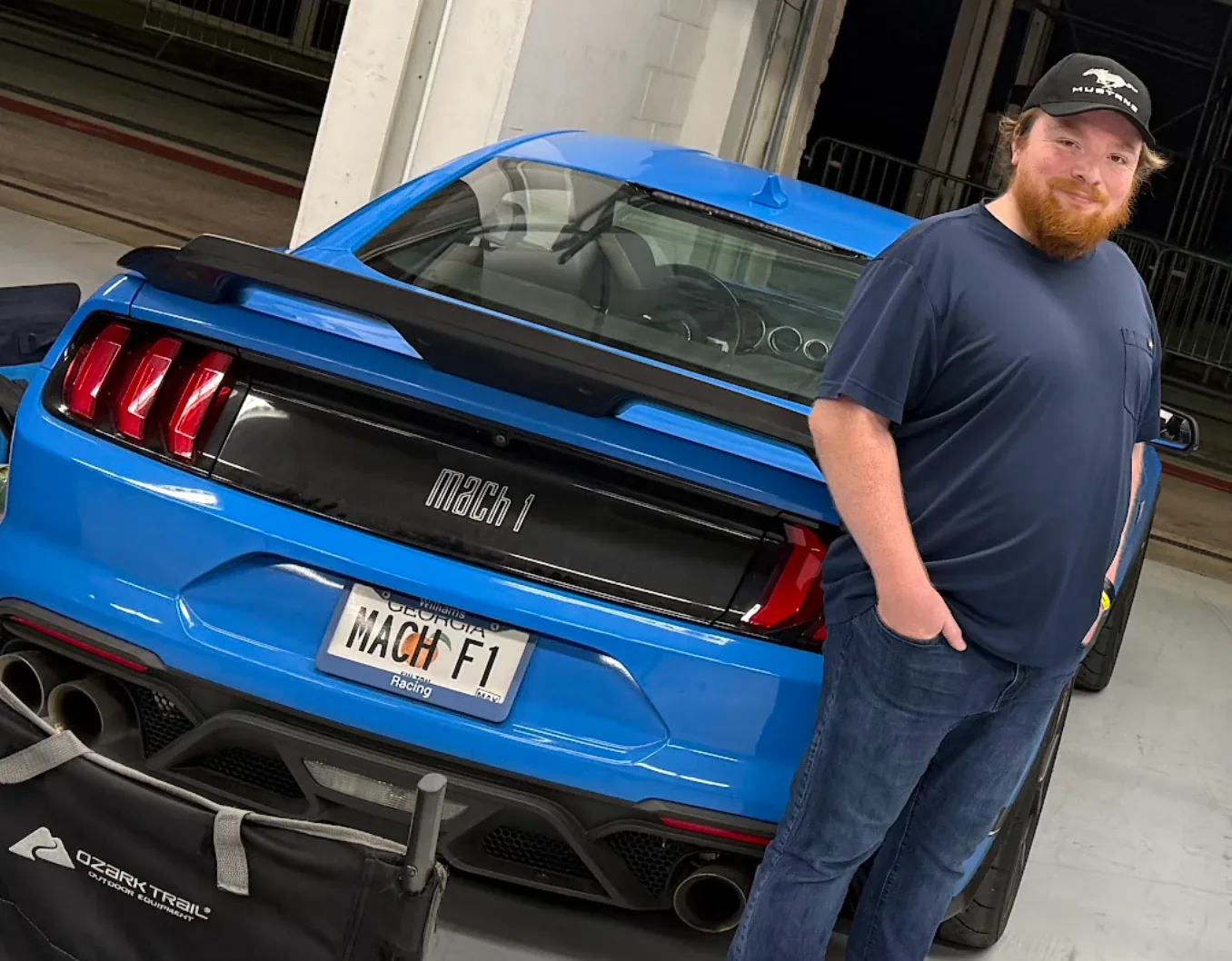
At the end of Sunday the track was drying. I decided not to push my luck and sat out the 4 pm happy hour. Zach went out. He suspected it was still wet, so he didn't run his timer. By the seat of his pants, and after reading this post, he thinks he was in the 2:38s, maybe even the 2:37s. I suspect he was. 😉 Lucky for me, he never timed it, so I guess this win goes to the old man.
Nice job, son. Zach has more than 50 track days, but only two track weekends in the last 12 months. I've had 20, which is 35 days at nine tracks. Proud of you, kiddo.
How we measured it
- 25 Hz GPS on every lap (Harry's LapTimer), with the phone's accelerometer.
- OBD on some sessions only. The dongle paired per session and dropped off after about 11:50 Saturday. Zach's 2:39.98 has throttle and rpm. My 2:38.87 has neither.
- No brake channel anywhere. Braking is inferred from deceleration calculated from GPS speed. Brake points compare one driver to the other; they aren't marker-board distances.
- Laps aligned on distance, timed from the real start/finish line. The lap timer's line fires about 885 ft past the real one. Timed from the real line, the margin is 1.177 seconds. Timed from the app's line, it's 1.110. Both are right; they time different stretches of track.
- Brake points, two ways. For lap-to-lap comparisons and medians, a brake point is where the speed peaks before the corner. In the T12 play-by-play it's where deceleration first passes 0.25 g. The two differ by a few dozen feet, so compare like with like.
- Every lap checked by path length. 82 full laps passed (77 in the Mach 1, 5 in the Supra), at 25 samples a second (the Supra laps at about 39) with no gaps. The fastest Saturday time on the sheet, a 2:31.06, failed: it was an in-lap that ended at pit entry, about 2,000 ft short of a full lap.
- Theoretical laps use connected sections: a boundary only counts if the speed you arrive with doesn't predict the next stretch. That's what keeps the stitch honest.
Want your laps analyzed like this? Email your exports, Harry's LapTimer .hlptrl, or CSVs from Porsche PTPA, AiM or RaceBox, to upload@trackdays.ai.