Fourteen Years, Eight and a Half Seconds: G29 vs E86 at Road Atlanta
Aug 19, 2026
Fourteen Years, Eight and a Half Seconds
AI-coached track weekends · Road Atlanta, July 2026. Same weekend as Two Z4s, One AI Race Engineer — but this time the two cars race each other, and the loser gets a build plan.
Same weekend: Two Z4s, One AI Race Engineer · The Race That Never Happened · The Mini Out-Cornered My M40i
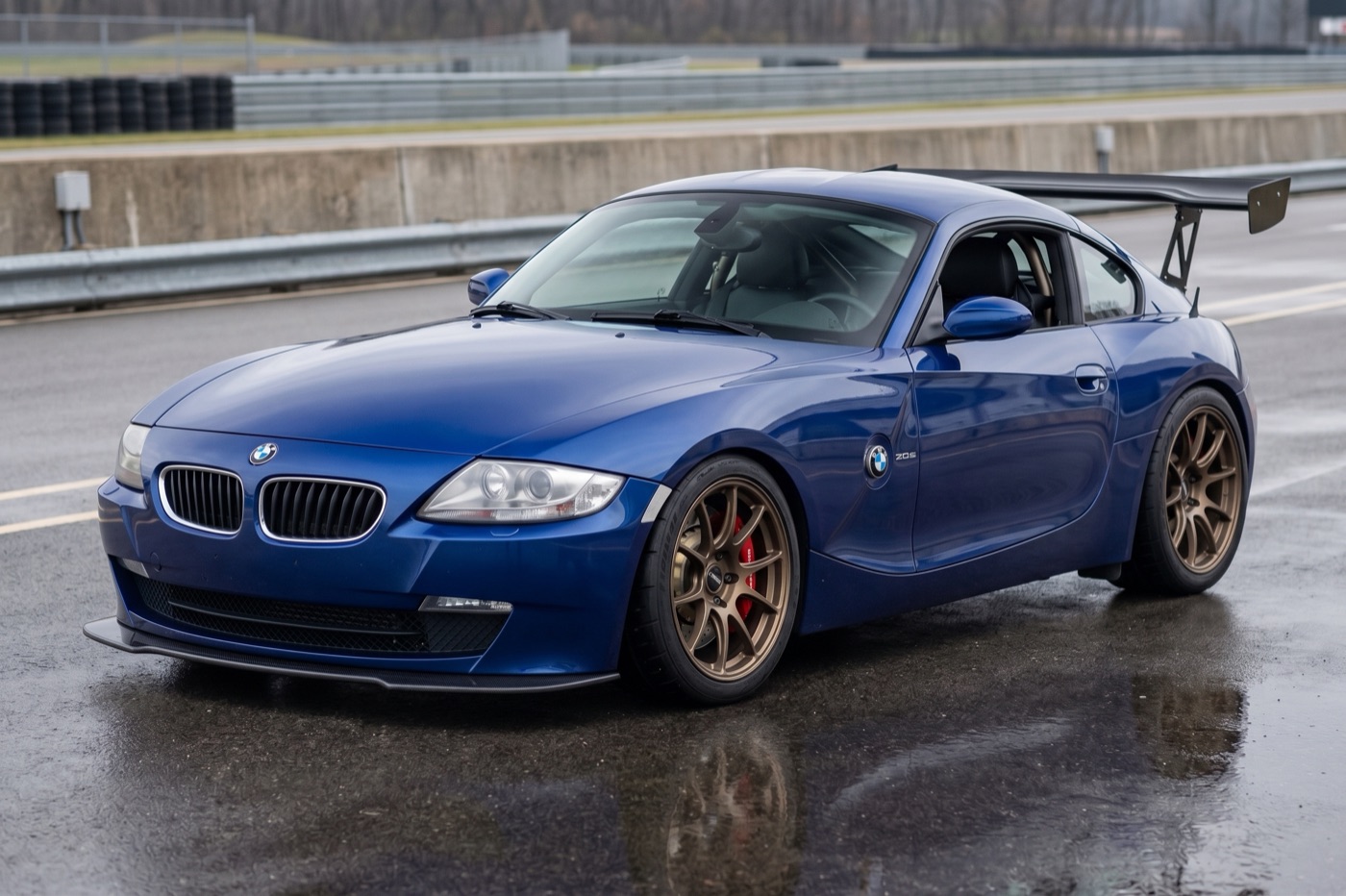 This car does not exist. It's an AI render of the build target — where the
2008 coupe is going, not what it is today. Bronze 18x9.5s, AP Racing calipers, a
splitter and a wing. Several years and a lot of money stand between this picture
and my garage. Keep it in mind while you read the next 8.46 seconds.
This car does not exist. It's an AI render of the build target — where the
2008 coupe is going, not what it is today. Bronze 18x9.5s, AP Racing calipers, a
splitter and a wing. Several years and a lot of money stand between this picture
and my garage. Keep it in mind while you read the next 8.46 seconds.
Two Z4s came home from Road Atlanta in July. The last post told you how they both got there — a snapped bleeder valve, a seven-day brake thrash, and a paddock with a 2008 coupe and a 2022 roadster wearing the same number stickers on alternating run groups.
What it didn't do was put them side by side.
2022 Z4 M40i, "Smurfette": 1:40.530. 2008 Z4 3.0si Coupe: 1:48.990.
Same driver. Same racetrack. Same weekend, same July heat. 8.46 seconds.
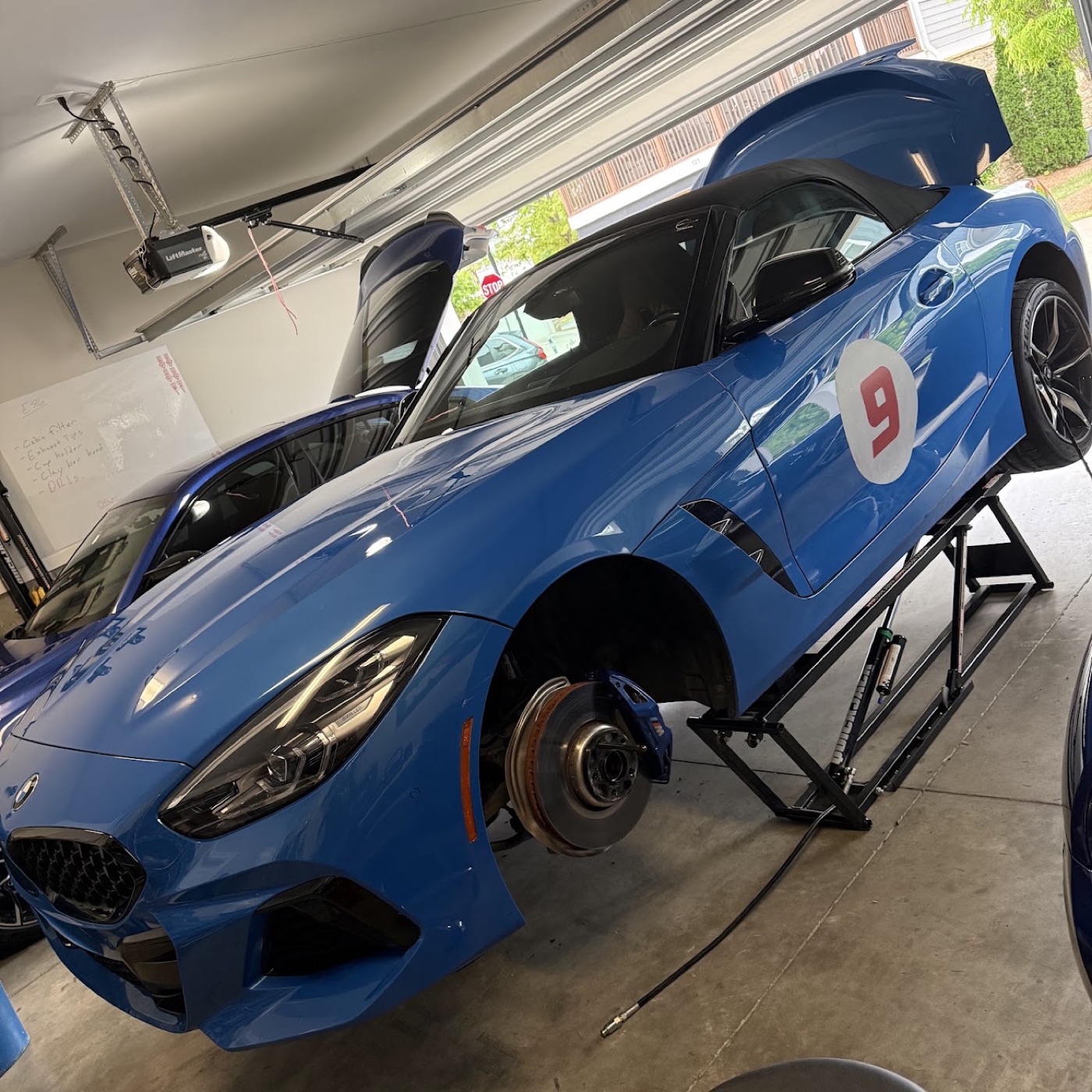 Two cars, one garage, one set of jack stands, and now one argument to settle.
Both cars are, in their own eras, the top-spec Z4 you could buy without a real M badge — and yes, I hear it: the M is right there in "M40i." It is a very nice letter. It is not a Z4 M. The M40i is the B58 turbo six with an eight-speed automatic; the 3.0si is the N52 naturally-aspirated six with a manual. Same brand, same idea, same slot in the lineup, fourteen model years apart. So how much of eight and a half seconds did BMW earn, and how much do I owe?
I aligned the two laps meter by meter and let them race. The answer surprised me, and it changed what I'm going to spend money on.
The two cars, on paper
| 2008 Z4 3.0si Coupe (E86) | 2022 Z4 M40i (G29) | |
|---|---|---|
| Engine | N52 3.0 naturally aspirated | B58 3.0 single-turbo |
| Power | ~255 hp (factory figure, approximate) | ~382 hp (factory figure, approximate) |
| Gearbox | 6-speed manual | 8-speed automatic |
| Weight | just under 3,000 lb | just over 3,500 lb |
| Tires that weekend | Toyo R888R 235/45R17 | Bridgestone RE-71RZ 275/35R19 square |
| Suspension | 100% stock, original springs, ~−1° camber | Camber plates, otherwise stock |
| Brakes | Fresh: new front calipers, four rotors, DTC-60, high-temp fluid | Stock, SRF fluid |
| Best lap, Road Atlanta | 1:48.990 | 1:40.530 |
Note the tires, because they cut against the story. The 2008 car is on semi-slicks. The 2022 car is on a very good street tire. Whatever the older car is losing, it isn't losing it for want of rubber.
The race
The method is the same one I built for Half a Second, Two Very Different Cars at Barber: cumulative distance from the raw GPS, each lap normalized to its own lap fraction, time interpolated onto a common grid, and one gap curve. The self-test is non-negotiable — the virtual margin at the stripe has to land exactly on the real lap-time gap. It does, to four decimal places: +8.4600 against a true margin of +8.4600.
Two things make this race cleaner than the Barber one. Both laps came off the same logger at 25 Hz — 2,728 fixes for the coupe, 2,516 for the roadster — so there's no coarse-versus-dense asterisk on any number below. And both laps came off the same driver on the same day, which means for once the difference genuinely is the machinery plus the driving, with no third variable smuggled in.
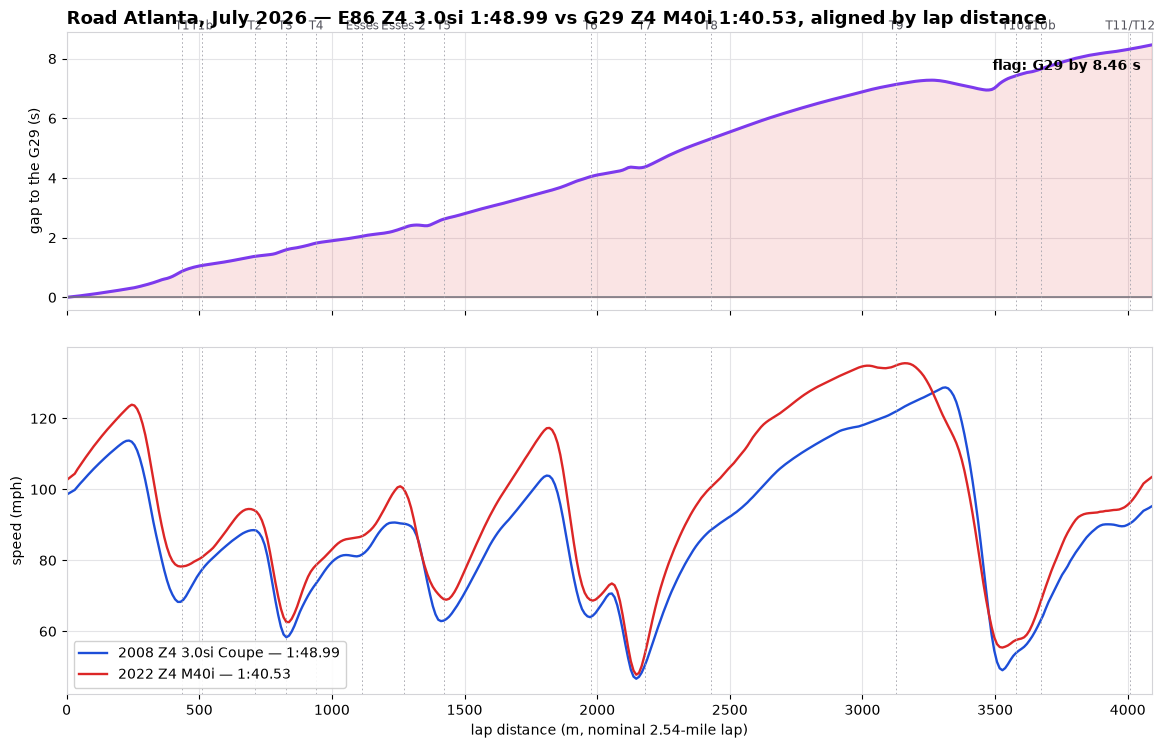 One lap of Road Atlanta. Top: the gap, growing from the green flag to the flag.
Bottom: both speed traces, in mph. The two big divergences are the climb to T6 and
the back straight — and everywhere else, the red line is simply a little higher.
One lap of Road Atlanta. Top: the gap, growing from the green flag to the flag.
Bottom: both speed traces, in mph. The two big divergences are the climb to T6 and
the back straight — and everywhere else, the red line is simply a little higher.
There is no drama in this gap trace. That's the point. At Barber the M3 and I traded the lead five times; here the roadster takes the lead ten meters in and never looks back. The 2008 car loses time in fourteen of the fifteen canon corner windows and in eight of the nine straights and links. It is a rout, and the interesting question isn't who but where.
Where 8.46 seconds actually lives
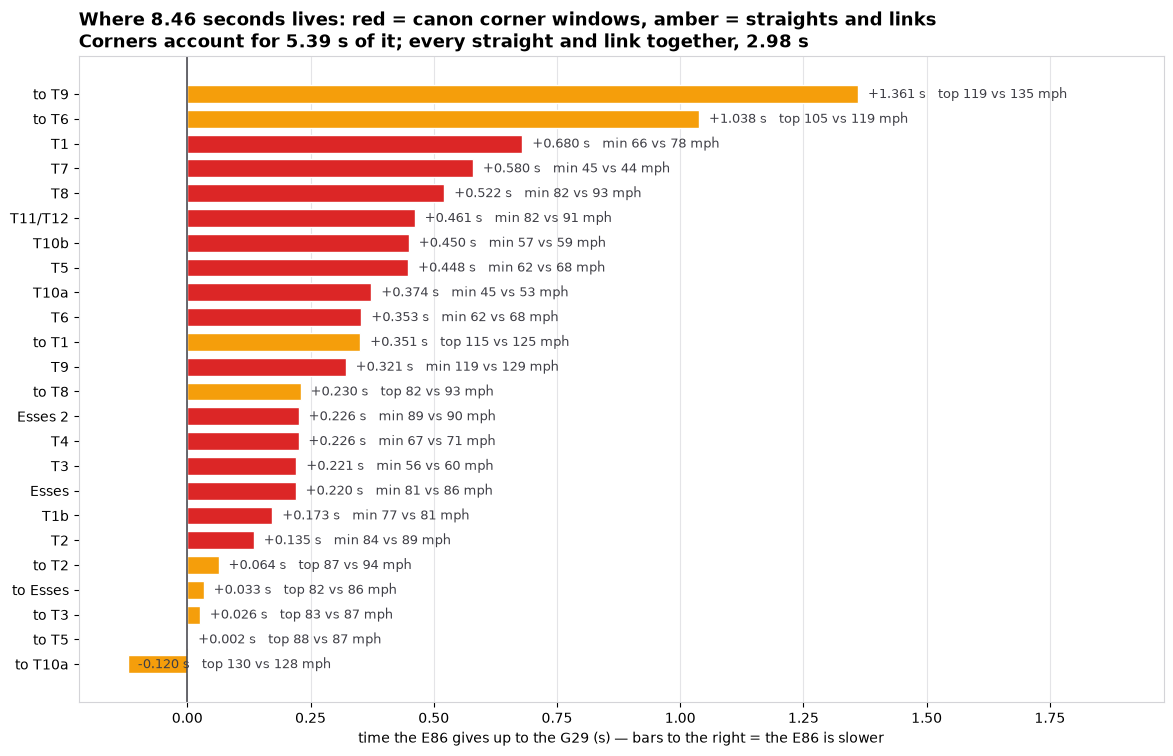 Red bars are the canon corner windows from our track model; amber are the
straights and links. The two amber bars at the top are the entire case for the
turbocharger.
Red bars are the canon corner windows from our track model; amber are the
straights and links. The two amber bars at the top are the entire case for the
turbocharger.
Split the lap into corners and not-corners and the whole race resolves into two numbers:
| Time the E86 gives up | |
|---|---|
| The fifteen canon corner windows | 5.389 s |
| Every straight and link combined | 2.984 s |
| Reconciled total | 8.374 s (margin 8.460 — corners never tile a whole lap exactly) |
Two-thirds of the gap is in the corners. That is the opposite of what I found at Barber, where my turbo car won 1.96 seconds on the straights and gave back 2.50 in the turns. Here the engine deficit — 127 horsepower and fourteen years of forced induction — accounts for roughly three of the eight and a half seconds, and it's concentrated in exactly two places:
| Straight | E86 | G29 | Time |
|---|---|---|---|
| The climb out of T5 to T6 | tops 105.4 mph | tops 119.1 mph | G29 +1.038 s |
| The back straight to T9 | tops 118.8 mph | tops 135.2 mph | G29 +1.361 s |
Two segments, 2.4 seconds, no driving involved. On the lap that produced these numbers the coupe's top speed was 129.7 mph and the roadster's 136.4.
And then there's the one place the 2008 car wins. From the end of the back straight into the braking zone for the chicane — 254 meters — the E86 is 0.120 seconds faster. Five hundred pounds lighter, semi-slick tires, and a brake system that was a pile of parts in a box five days earlier. It is the only segment of Road Atlanta the old car takes, and I'll take it.
Every corner, in order
Minimum speeds in mph, because minimum speed is the money stat:
| Corner | E86 min | G29 min | Δ | Time |
|---|---|---|---|---|
| T1 | 66.1 | 78.0 | −11.8 | G29 +0.680 |
| T1 second phase | 76.9 | 80.9 | −3.9 | G29 +0.173 |
| T2 | 84.4 | 88.8 | −4.3 | G29 +0.135 |
| T3 | 56.2 | 60.1 | −4.0 | G29 +0.221 |
| T4 | 66.9 | 71.4 | −4.6 | G29 +0.226 |
| The Esses (1) | 80.8 | 86.1 | −5.3 | G29 +0.220 |
| The Esses (2) | 89.4 | 89.7 | −0.3 | G29 +0.226 |
| T5 | 61.9 | 67.6 | −5.6 | G29 +0.448 |
| T6 | 62.1 | 67.6 | −5.4 | G29 +0.353 |
| T7 | 44.8 | 44.0 | +0.8 | G29 +0.580 |
| T8 | 82.4 | 93.5 | −11.1 | G29 +0.522 |
| T9 | 119.0 | 128.9 | −9.8 | G29 +0.321 |
| T10a | 45.3 | 53.1 | −7.7 | G29 +0.374 |
| T10b | 57.1 | 58.5 | −1.4 | G29 +0.450 |
| T11/T12 | 82.2 | 91.3 | −9.2 | G29 +0.461 |
Corner names are the club labels off our own Road Atlanta model — the Esses carry no number on either the JTI or the Chin map, and T11 and T12 are one continuous arc to the flag, so they're measured as one.
T1 is the single worst corner of the lap, and it's a braking corner: 112.1 mph on entry against 125.3, then 66.1 through the middle against 78.0. Twelve miles an hour at the slowest point of Road Atlanta's fastest real corner, worth 0.68 seconds before we're an eighth of the way around.
And then look at T7. The 2008 car's minimum speed is higher — 44.8 against 44.0 — and it still loses 0.58 seconds, the second-biggest corner loss on the lap. Every bit of that damage happens after the apex. Exit speed: 73.4 mph against 83.7. Ten miles an hour of exit out of the slowest corner on the circuit, with an identical apex. That is not a driving problem and it is not a power problem at those speeds. That is an open differential putting the power down through whichever rear wheel is least interested.
And then the coupe out-braked the roadster
Both of these laps came off the same logger with a real accelerometer, on the same afternoon, so for once the deceleration numbers are comparable. Which means I can tell you this: at the chicane, the 2008 car brakes harder than the 2022 car.
| Into the chicane (T10a) | E86 | G29 |
|---|---|---|
| Speed when hard braking starts | 121.4 mph | 106.1 mph |
| Peak deceleration | −0.87 g | −0.66 g |
| Hard-braking distance | 148 m | 139 m |
| Minimum speed | 45.3 | 53.1 |
−0.87 g is the biggest stop either car makes anywhere on either lap; the roadster's best is −0.85 g, and at the chicane it only manages −0.66. The coupe is still doing 121 mph where the roadster is already down to 106, and it hauls that back harder. This is exactly as it should be: five hundred pounds lighter, Hawk DTC-60 race pads and fresh high-temp fluid against the roadster's stock OEM pads — even with stock calipers and stock rotors. This is also the only segment of the whole lap the coupe wins on time, and now we know why.
And then it throws it away. Minimum speed 45.3 against 53.1 — nearly eight mph of over-slowing, in the corner where I've already confessed to taking two full seconds to reach 90% of peak brake pressure. The brakes are better than the driver. Best brake pedal in the family, attached to the guy still learning where it is.
The rest of the lap is the other story. At T1 the roadster stops harder (−0.72 g to −0.55) and at T6 it isn't close: −0.85 g over 99 metres against the coupe's −0.57 g dragged out over 231. That 231-metre smear is the slow-build habit in one number, and it's the habit the pedals and the practice are aimed at.
One thing I'm deliberately not publishing: a peak lateral g comparison between the two cars. That's a grip-ceiling number, confounded by two different tires and a degree-and-a-half of camber, and the coupe's Saturday file contains a −1.83 g spike that's a curb artifact rather than a stop. Longitudinal on these two Sunday laps is fair; lateral isn't, so it stays out.
What fourteen years bought
Three of the eight and a half seconds are the engine, and I can't argue with those.
The rest is quieter and more interesting. Go back down that corner table and look at the size of the deltas: −3.9, −4.3, −4.0, −4.6, −5.3. Nearly every corner on the circuit costs the coupe four to six miles an hour of minimum speed, and none of those individually looks like a headline. Added up, that drip is most of the 5.39 seconds. Fourteen years of BMW development didn't buy one big trick — it bought half a mile an hour here and two there, in dampers, in bushings, in geometry, in the fact that a 2022 chassis stops moving around the instant you ask it to.
The two exceptions are the corners where a specific missing part shows up in the data with a name on it. T7's ten mph of exit is the open diff. T8 and T11/T12's nine-to-eleven mph of sustained speed through a long, loaded, single-radius arc is a car sitting on fourteen-year-old spring rates at one degree of negative camber, running out of tire before it runs out of grip.
Which is a nice thing to discover, because dampers, camber and a differential all have part numbers.
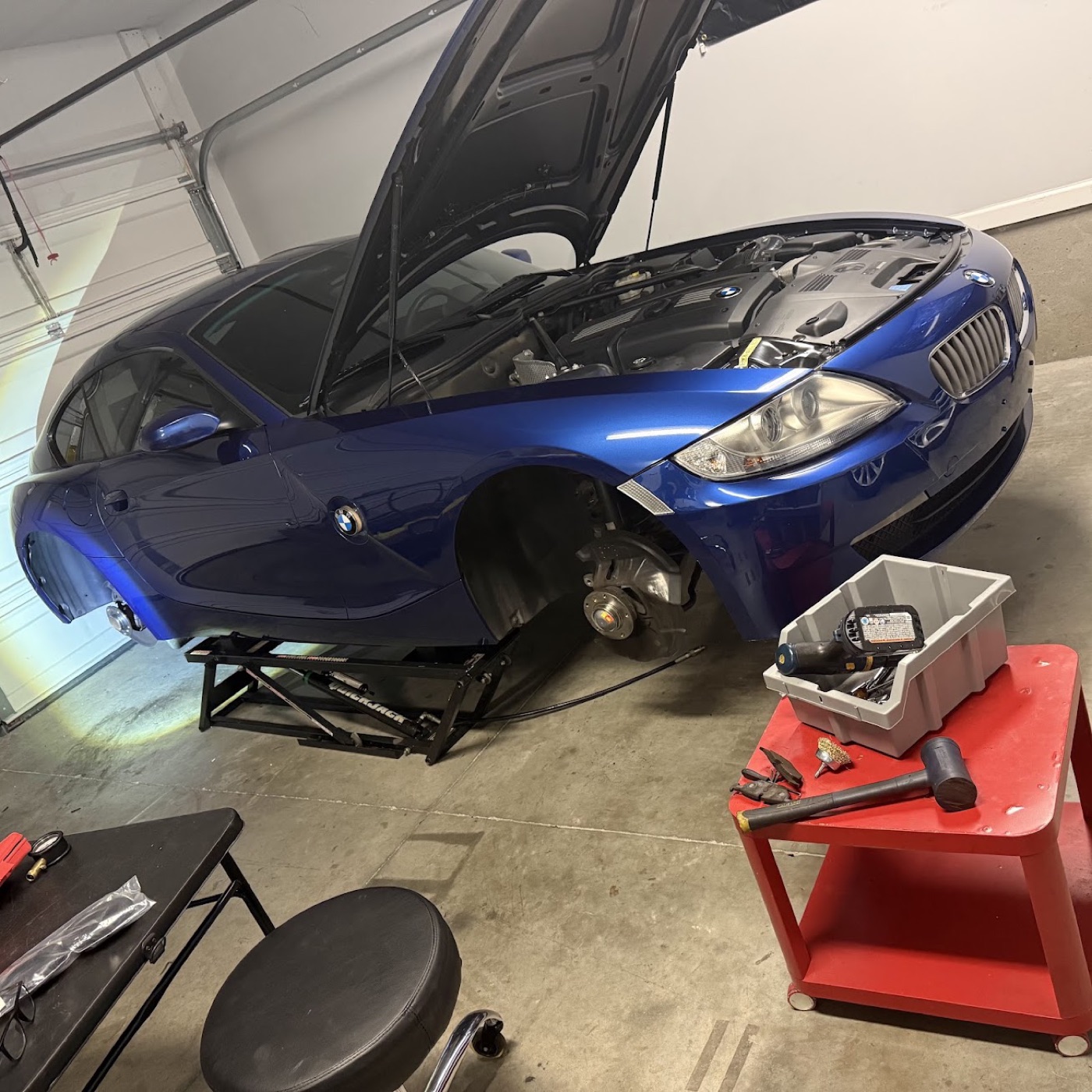
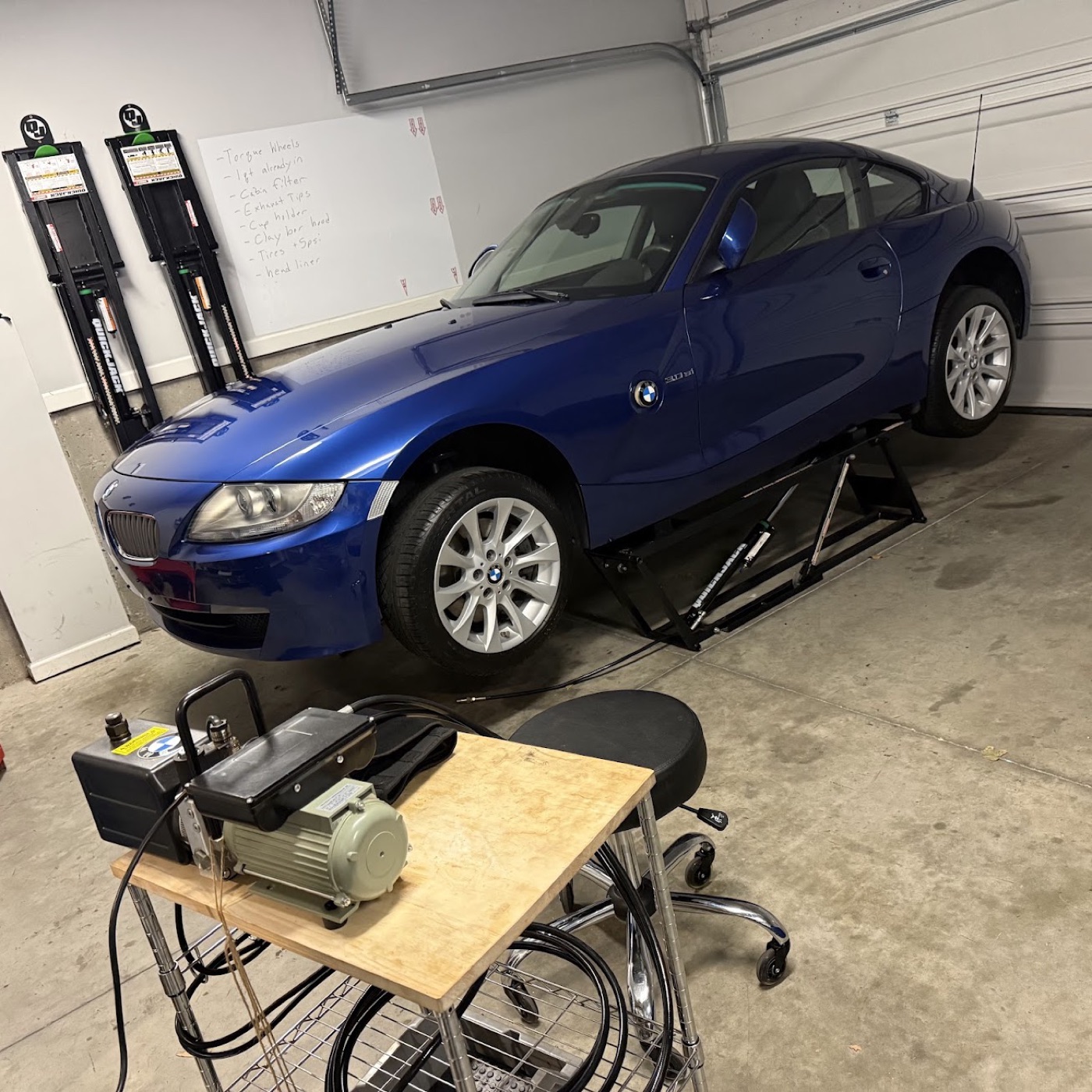 The E86 the week it arrived. The whiteboard is the whole plan at that point: torque the wheels, cabin filter, exhaust tips, clay bar the hood, headliner. Nothing on that list makes it faster.
What the driver owes
Here's the part that stings, and it's the part with the data behind it.
Of the 5.39 seconds sitting in the corners, roughly one to one and a quarter seconds a lap is measurably me not getting to the brake pedal. Not braking too late, not braking too early — building pressure too slowly. Road Atlanta's chicane entry owns that number by itself: the coupe takes about two seconds to reach 90% of its peak braking there, where every other corner on the lap takes half a second to one second. The grip exists earlier than I use it. That one corner is worth 0.37 to 0.48 seconds a lap.
And this was my first serious stick-shift track weekend in years. I was learning heel-toe rev-matching on track, at speed. That shows up as dips — a brake trace that goes soft mid-zone while the right foot is busy somewhere else. The coupe averaged 3.34 dips a lap at Road Atlanta. Driving the same corners at the same 25 Hz in an automatic, I average 1.65. The clutch pedal costs me roughly two brake-release events per lap that I don't pay for in a car that shifts itself.
The honest wrinkle: the automatic also builds pressure slowly. So the slow build is my habit, not the gearbox's fault. What the manual adds is the dips. Those are two different problems with two different fixes, and only one of them can be bought.
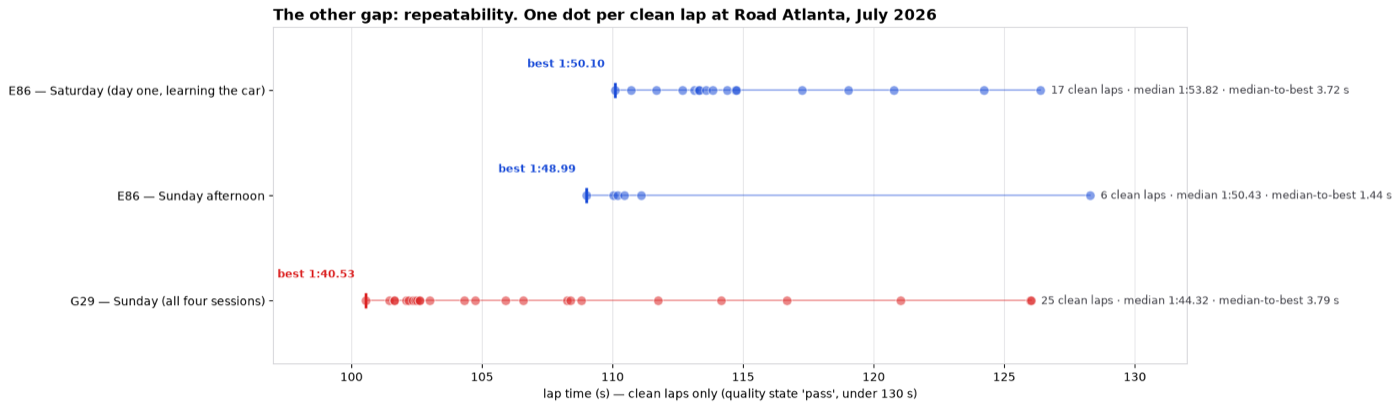 Read this one carefully, because the obvious reading is wrong.
That chart needs a caveat and then a compliment. The roadster's 25 clean laps are a whole Sunday across four sessions — instructing, traffic, cool-down laps, the lot — so its wide spread isn't a repeatability failure, it's a day. The honest comparison is the shape of the coupe's two days: Saturday's median was 1:53.82, Sunday's was 1:50.43. Three and a half seconds of median in one day, which is what learning a car looks like in numbers.
And then the compliment, which is also the ceiling: Sunday's six clean laps sit inside 2.1 seconds of each other, and my fastest lap of the weekend was the fifth lap of that session. Ten more laps produced nothing. I found the car's limit with what I currently know how to do, and then I sat on it for ten minutes.
Which is a very clear message. The driver's remaining second a lap is in braking. Everything past that needs parts.
Open season
The G29's build is essentially finished, and that's a decision, not an accident. Camber plates are on. Tires are the right tires. It's under warranty until 2029, and I like it that way — so nothing goes on that car that a dealer could point at. The one thing I'd genuinely consider is the same DINAN portfolio I put on the G26, because I've done it before and I know exactly what it does. Even that waits. Until 2029, Smurfette is the control group.
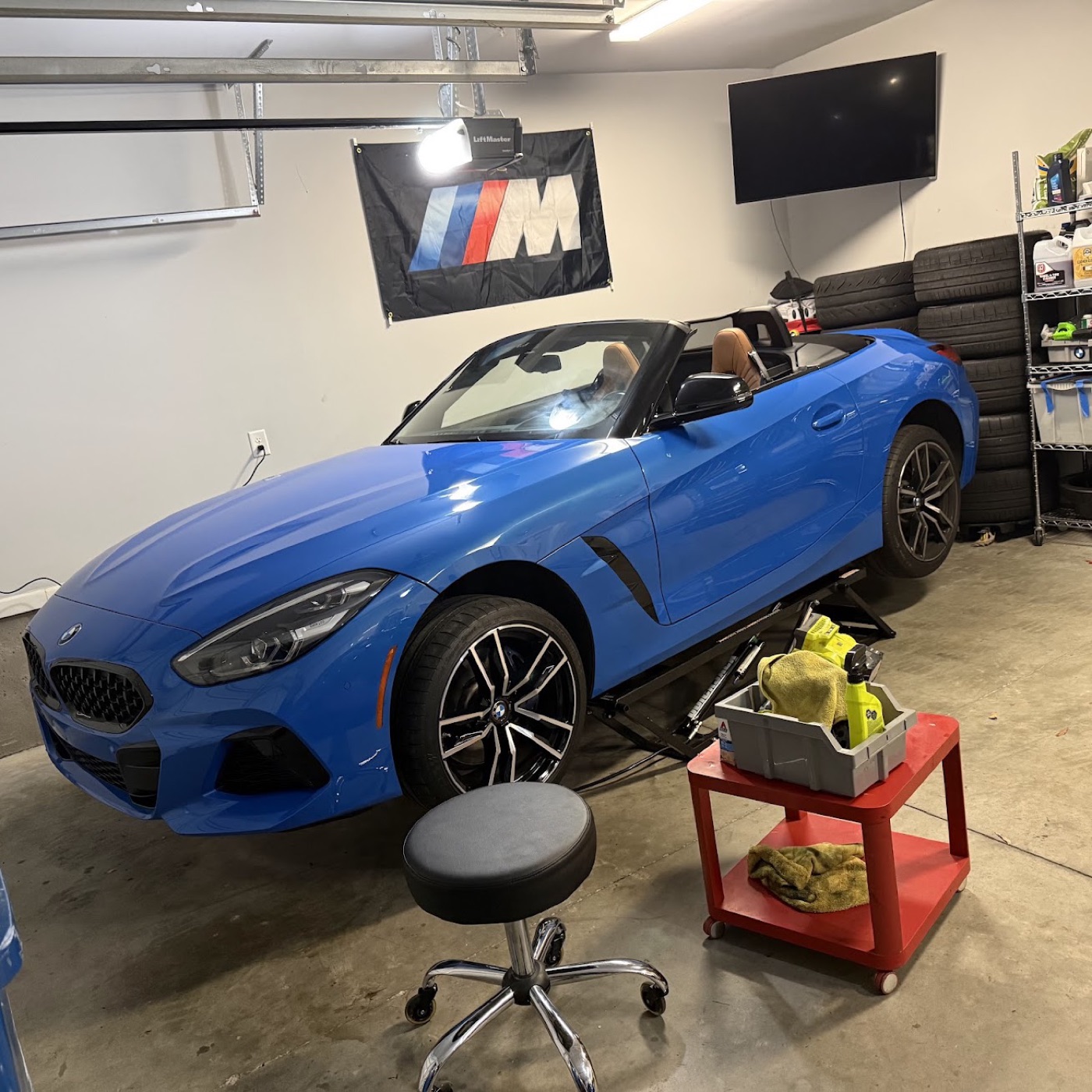 The finished car. Camber plates, the right tires, and a warranty that says stop here.
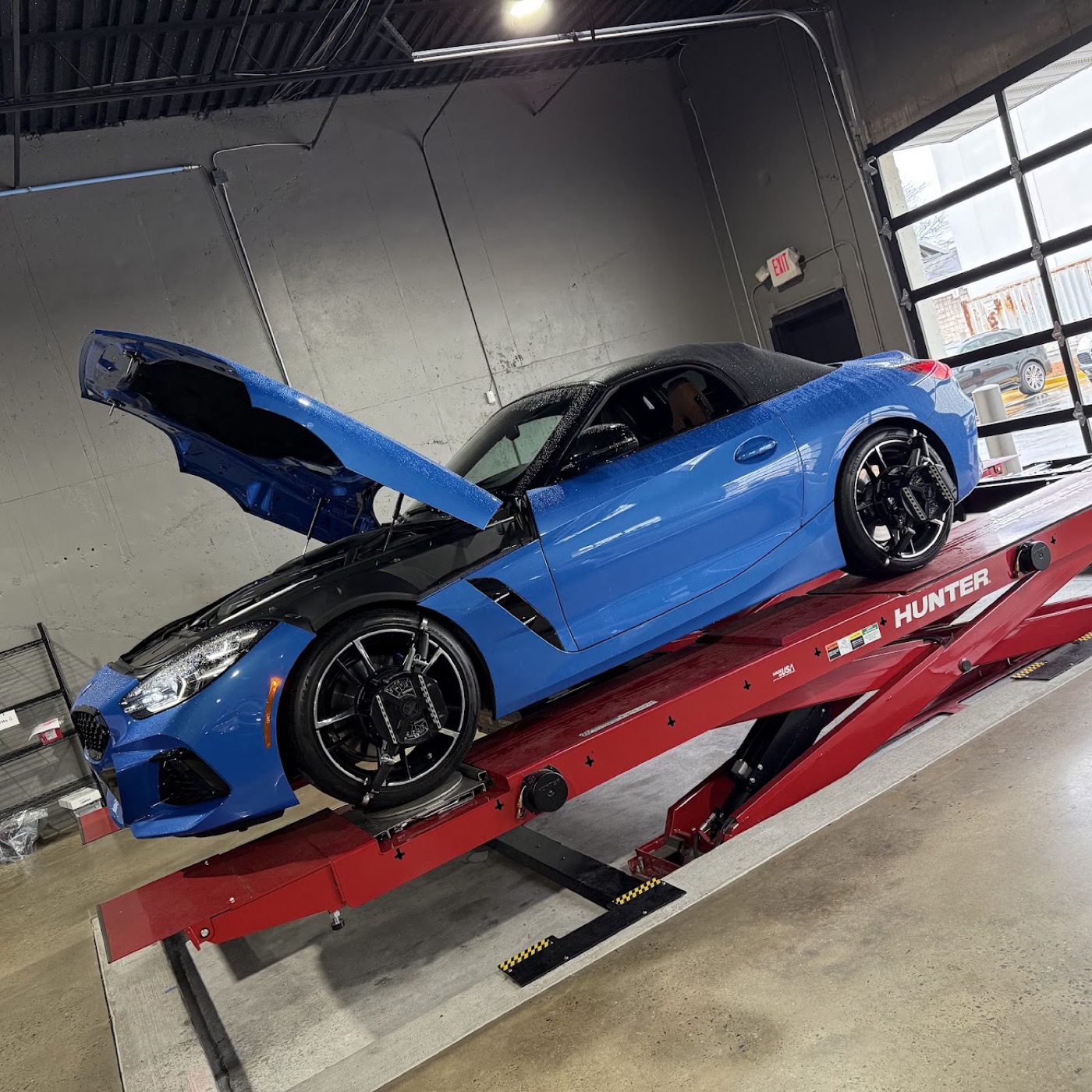 Which is not the same as "leave it alone." Alignment is free speed and it doesn't void anything.
The E86 is the opposite. It's a base-spec 2008 coupe with zero options, manual seats and no navigation. There is no warranty, no resale case worth protecting, and nothing on it that's precious. It is open season.
 Open season.
Here is the whole plan in two pictures. Before, and where it's going:
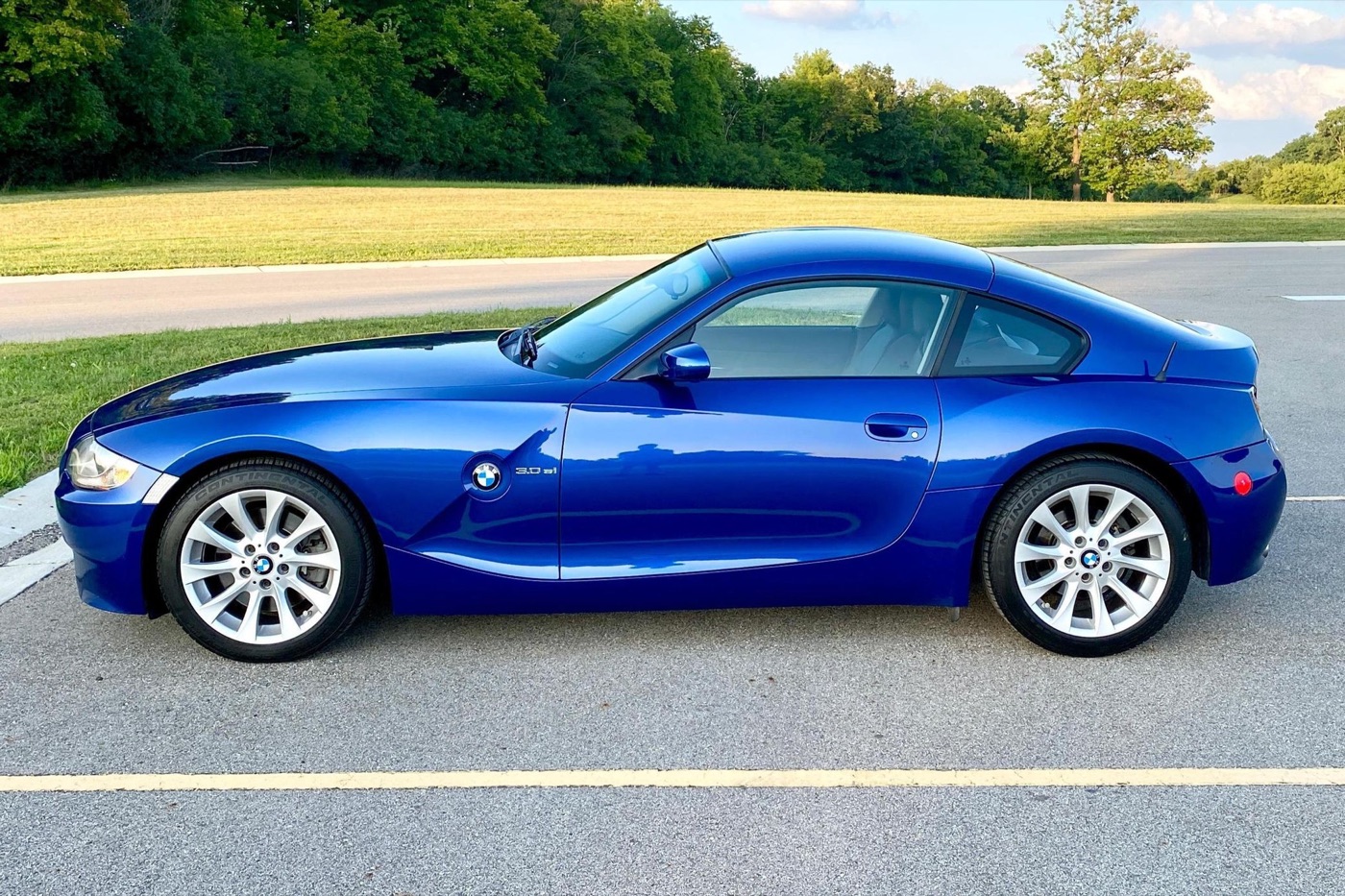 Before. Exactly as it ran the 1:48.990 — factory 17s, factory ride height,
one degree of negative camber, no options.
Before. Exactly as it ran the 1:48.990 — factory 17s, factory ride height,
one degree of negative camber, no options.
After — or rather, target. This is an AI render, not a photograph: nothing in
this picture has been bought yet except the intent. Bronze 18x9.5s on 265s, AP
Racing up front, MCS 2WNR underneath, minus three degrees of camber, and aero I
haven't even put a line item against. Years away. But this is the car that has to
run a 1:40.5.
The plan is written down, it's ordered by dependency rather than by excitement, and it will take years. Best parts, patient money. Every step has to be independently useful, and no step is allowed to be made pointless by a later one. Roughly:
Pedals first, because they're in hand and they're the fix for the exact geometry problem behind those 3.34 dips a lap. Heel-toe is partly a technique and partly a question of where the pedal faces are. The stock-pedal baselines are already banked at Road Atlanta and Barber, so this one gets a clean A/B.
Then a seat, which is not a lap-time part and is on the list anyway. You can't be precise with the brake pedal while you're bracing against the door card.
Then the differential — a proper clutch-type limited-slip in place of the open one, sourced as a built unit rather than a used pull, staying on the 3.62 ratio because a shorter ratio just adds a shift per straight on a naturally-aspirated engine. This is the one with a number attached to it already: T7's ten miles an hour of exit.
Then spindles and coilovers together — and the camber plates with them, one job, one alignment, one corner balance. The dampers are decided: MCS 2WNR, double-adjustable. The camber plates ride on the coilover's own spring perch, which is exactly why they wait for this step instead of going on early — the stock-spring plate and the coilover plate aren't the same part, and I'm not buying the geometry twice. Out of this one job comes minus two and a half to three degrees of front camber instead of one, the grip I expect to pay off in exactly the corners that leak four to six mph today. KW Clubsports were the other finalist and lost the argument the moment the spindle swap entered the plan. The spindles are also the part that quietly unlocks the rest of the catalog — including the brakes two steps down.
Then wheels — 18x9.5 square with a 265-section tire, which happens to come out at the exact same rolling diameter as today's 17s, so the speedometer, the gearing and the ABS all stay honest. Lighter, and lighter in the place where it counts.
Then the front brakes — AP Racing. Calipers and rotors both: the six-piston Radi-CAL front kit with the J-hook rotors, which fits only because of the spindles, and which runs happily on the stock master cylinder, stock ABS and the stock rear brakes for as long as I like. Then, someday, the AP rears — which is a nicer problem to have than most, given what the stock front brakes already did to the roadster at the chicane.
Nothing about that list is fast. It's a multi-year plan on a car that has to also be a street car, and the whole point of writing it down in dependency order is that I don't buy the exciting thing first and then have to buy it twice.
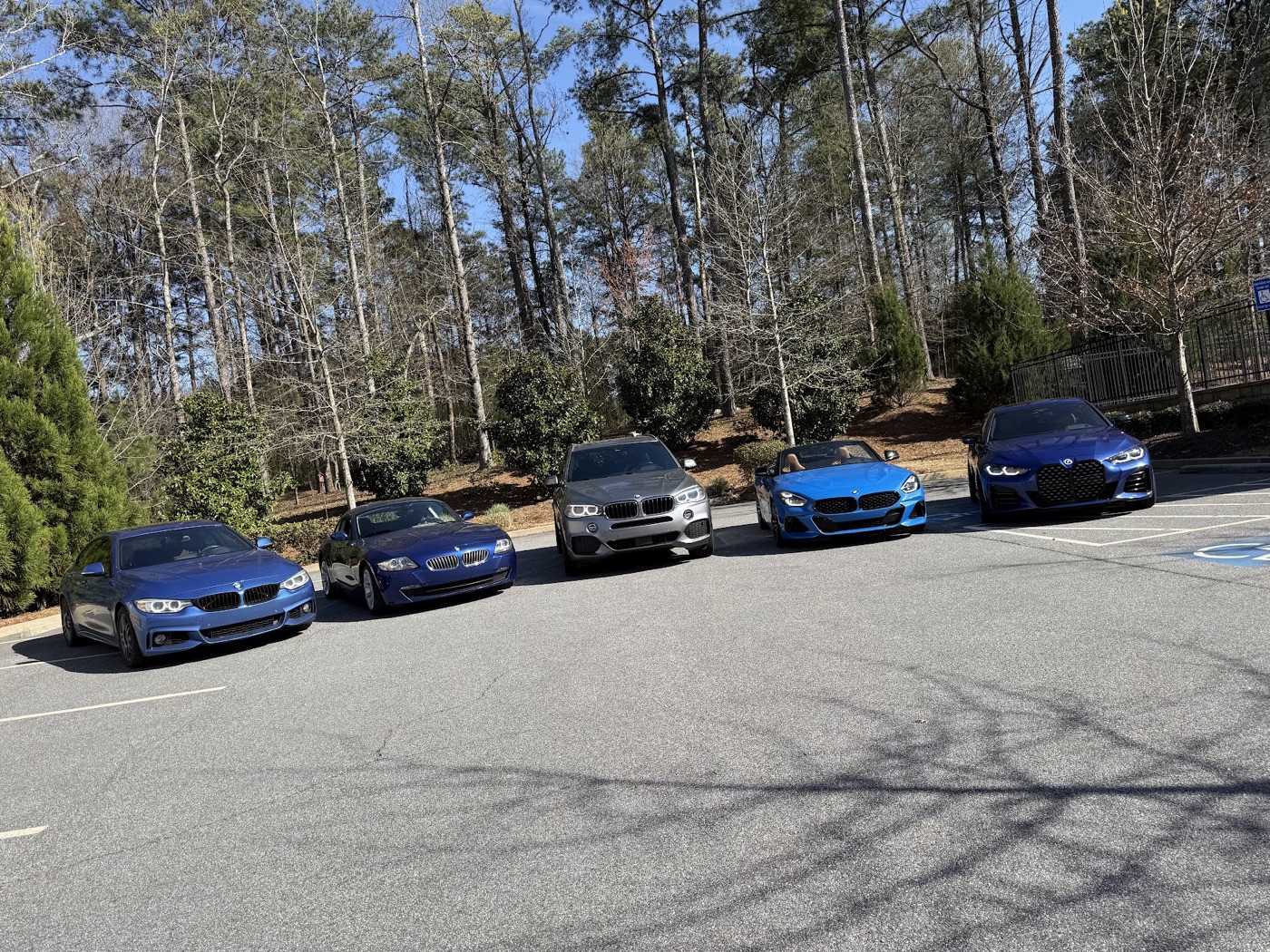 The whole cast. The two that matter to this post are second and fourth from the left.
The race is on
Here's the goal, and it isn't subtle.
At Barber in August I ran a virtual race against a friend's race-prepped E36 M3 — caged, built S50, proper dampers, aero — and lost by 0.537 seconds. A fully built nineties M car, half a second up the road from my mostly-stock automatic. That's what told me the target was reachable: the gap between a street car and a real track car, on a driver like me, is tenths, not eras.
So: get the E86 around a racetrack faster than the G29. Whatever it takes.
Eight and a half seconds is a lot. But three of those seconds are the engine, and the coupe gets to keep chipping at the other five and a half — five and a half that live in dampers, camber, a differential, tires, and about a second a lap of my own right foot. Every one of those is a line item or a practice session.
And every single step is another one of these posts. That's the format now: the coupe gets a part, or I get a little better, and then the two Z4s go back to Road Atlanta and I run the same alignment against the same 1:40.53 ghost and publish the new margin. 8.46 today. Whatever it is next time. The whole thing is a stopwatch with a build sheet attached.
The next two battlegrounds are already booked, and they're deliberately split:
- Ozark International Raceway, September 5–6. The G29 goes, towed. Nineteen corners I have never seen, and I'm not learning a new track and a new gearbox in the same weekend. Smurfette gets un-demoted for one event.
- Atlanta Motorsports Park, September 12–13. The coupe. The heel-toe program continues on a track where nothing is flat and I already know where everything is.
- Road Atlanta, September 26–27. The coupe again, still on its stock suspension — the next time this exact comparison gets re-run, same track, same stopwatch, with a winter of build work waiting on the other side of it.
The first Smurfette, and the best race I ever lost
One more picture, because the "race is on" framing didn't start with a build sheet. It started with my son.
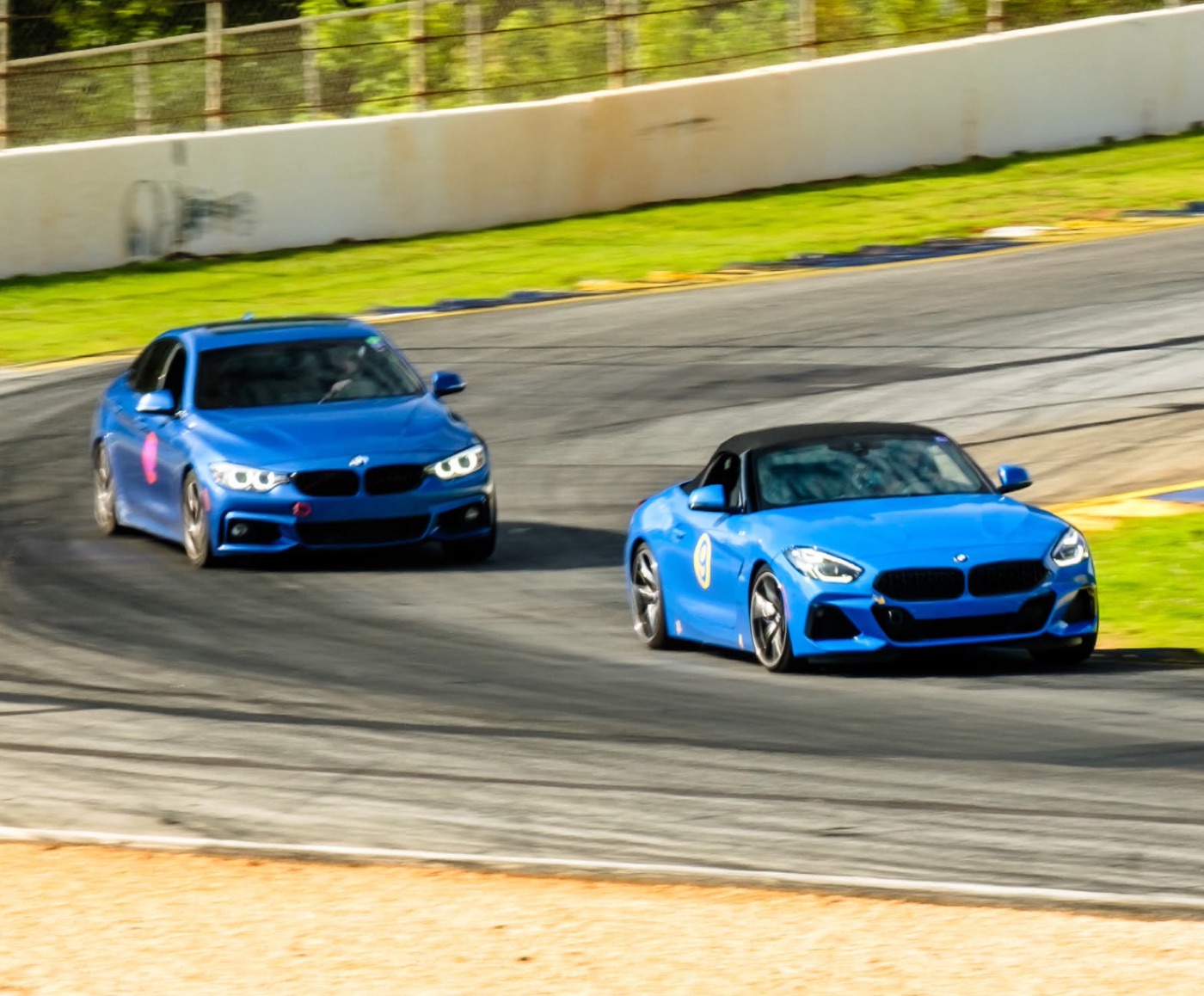 Road Atlanta, 2025. Zach in the 428i, me in the first Smurfette — a G29 Z4
sDrive30i, not the M40i this post is about. Same name, different car.
Road Atlanta, 2025. Zach in the 428i, me in the first Smurfette — a G29 Z4
sDrive30i, not the M40i this post is about. Same name, different car.
That is the closest thing to a real HPDE race I've had. Zach was in the 428i on Falken RS4s; I was in the old Smurfette, a Z4 sDrive30i on Michelin Pilot Sport 4S. I lined five cars up behind him and went after him.
It took me eight laps to clear traffic and finally catch the 428's bumper at the end of the back straight. He gave me the point-by — and then never lifted, which meant the only way past was to take 10a on the left curb and take the chicane from somewhere no line chart has ever recommended, and at a crawl. I trusted my boy would slow down before he turned into my bumper.
That's my boy — "making me earn it!" Wouldn't have it any other way.
Mike keeps the Barber trophy. Smurfette — this Smurfette, the M40i — keeps the Road Atlanta record. For now.
The virtual-race method — lap-fraction alignment, the mandatory margin self-test, and the things it deliberately refuses to compare across loggers — is written up in the Barber post. Corner windows and labels come from our own Road Atlanta model, rebuilt from five clean laps by GPS curvature and checked against a walk of the circuit.