The Tie, Then the PB: Road Atlanta to the Millisecond
Jun 5, 2026
The Tie, Then the PB: Road Atlanta to the Millisecond
AI-coached track weekends · Road Atlanta, June 2026. In the Barber post, two great coaches — Rich and Claude — found me 2.57 seconds at Barber. Five days later, Road Atlanta had a stranger lesson waiting.
Two weeks after Barber, I was pretty sure I understood what was going on. AI sector analysis had flagged the same three corners a good coach later confirmed live, I dropped 2.57 seconds in a day, and the lesson felt clean: brake later, brake harder, brake shorter — not softer. I wrote that down as the takeaway and moved on to the next track.
Road Atlanta had a different lesson waiting, and it took a genuinely strange coincidence to surface it.
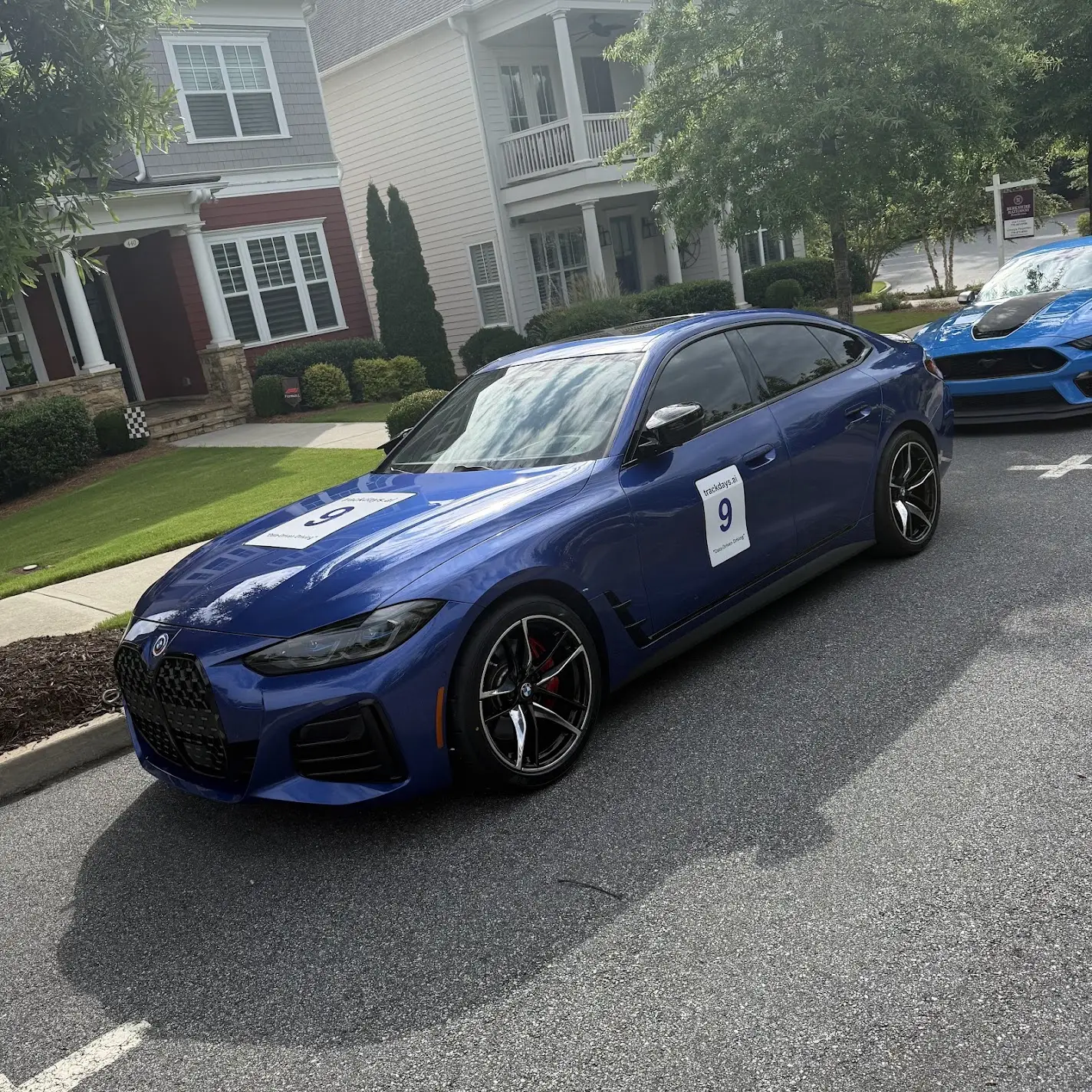 The commute: Road Atlanta is 45 minutes from my driveway. The number-9
stickers went on the day the car was prepped and stayed on until after VIR.
The commute: Road Atlanta is 45 minutes from my driveway. The number-9
stickers went on the day the car was prepped and stayed on until after VIR.
Same number, twice
Friday, June 5th, JTI at Road Atlanta. I was driving the M440i, instructing a student that day, and testing something new: a pre-built "attack analysis" the AI had generated from my Road Atlanta history before I ever turned a wheel — which corners to attack, which habits to expect, waiting in my pocket when I pulled into the paddock.
The first session of the morning produced a 1:44.19.
I assumed it was a new PB. It wasn't. It was an exact tie with my June 2024 Road Atlanta best in the same car — 104,190 milliseconds, both times, to the millisecond. My first thought was data corruption. It wasn't that either: today's lap was genuine 25Hz telemetry with today's timestamps, 2,609 GPS/IMU fixes against the 2024 lap's 109 (1Hz). And the coincidence runs deeper than the stopwatch: both laps were set on a Friday in early June, two years apart — lap 12 of the session in 2024, lap 13 in 2026. Two different data resolutions, two different pipelines, landing on the identical millisecond felt unlikely enough that I went looking for the story underneath it, because the story is never really the lap time.
Tying a number by driving a different lap
Here's the part that actually matters. Same 1:44.19, completely different driving underneath it — this is the two tie laps, side by side:
| Zone | 2026 (25Hz) | 2024 (1Hz) | Coaching target | Executed? |
|---|---|---|---|---|
| T3 Esses entry | 1.02g lateral | 0.70g | 0.95g+ | Nailed — +0.32g |
| T4 mid-Esses | 1.09g | 1.03g | — | More committed |
| Chicane (T10a/b) | 1.15g lateral | 1.09g | Commit to the brake | More committed |
| T12 brake | 0.79g | 0.78g | 0.95g | No change at all |
| Back straight peak | 127.6 mph | 131.5 mph | Max it | Didn't reach the cap |
Read that table straight across and it tells you something a lap-time chart never could: I drove the technical sections — the Esses especially — meaningfully better than I did two years ago. My Esses entry g went from 0.70 to 1.02, which is exactly the corner the pre-event attack analysis had flagged before I ever turned a wheel that day. That lesson landed.
And Turn 12 braking? 0.79g. Identical, to two decimal places, to 2024. Two years, a data pipeline upgrade, and zero change in how hard I'm willing to brake into that corner — a corner where I'd already proven, at Barber two weeks earlier, that I can brake at 1.06g without drama. I had the number. I just wasn't using it here.
Same story on the back straight: 127.6 mph in 2026 against 131.5 in 2024. The car runs a 130 mph limiter — the tune hasn't touched it — and in 2024 I was right at the cap. This year I never got there: too much traffic, not enough clean exits onto the straight. That's free time I didn't collect.
So the tie isn't "I'm exactly as fast as I was two years ago." It's "I made up an entire corner's worth of brand-new cornering commitment, and spent all of it exactly offsetting a braking habit I still haven't fixed." Same ceiling, completely different floor holding it up. That's not a coincidence you can see on a stopwatch. You need the corner-by-corner trace to even ask the question.
Then the actual PB
An hour later, next session out, the morning's homework cashed in: 1:43.50, backed up by a 1:43.55 two laps earlier in the same session. Not a tie this time — a real PB, 0.69 seconds under the number that had stood for two years, in a 4,200-pound car the spec sheet politely calls a family hauler.
The 1:43.50, onboard.That's the sequence that makes the tie worth writing about: the tie told me exactly where the time was (Esses banked, T12 and the straight still owed), and the very next session converted part of the debt. The T12 brake number and a clean run to the 130 cap are still out there — which is why 1:43.50 doesn't feel like a ceiling either.
The human half: Levi's three tips
The Barber post's argument was that I want both kinds of coach, and Road Atlanta ran the play again with a different cast. Levi — an old friend and the chief instructor — rode along in the afternoon, while Rich, my coach from Barber, tagged along taking photos. Reviewing the day with Levi, he gave me three things to work on: T1, T5, T12.
That's the coach's half of the loop doing what no telemetry can: he was in the car, feeling what I was doing, and his three corners came from watching me drive, not from a g-trace. The AI's half was what happened next — checking each of his three against the data, corner by corner.
T12 you've already seen — untouched through the tie lap, still on the table even on the PB. Levi called it from the passenger seat; the trace agreed to two decimal places.
T1 turned into the most interesting thread of the weekend, because T1 is where I put a BMW into the wall in 2022, and I've been quietly cautious about entry speed there ever since.
The old ghost in Turn 1
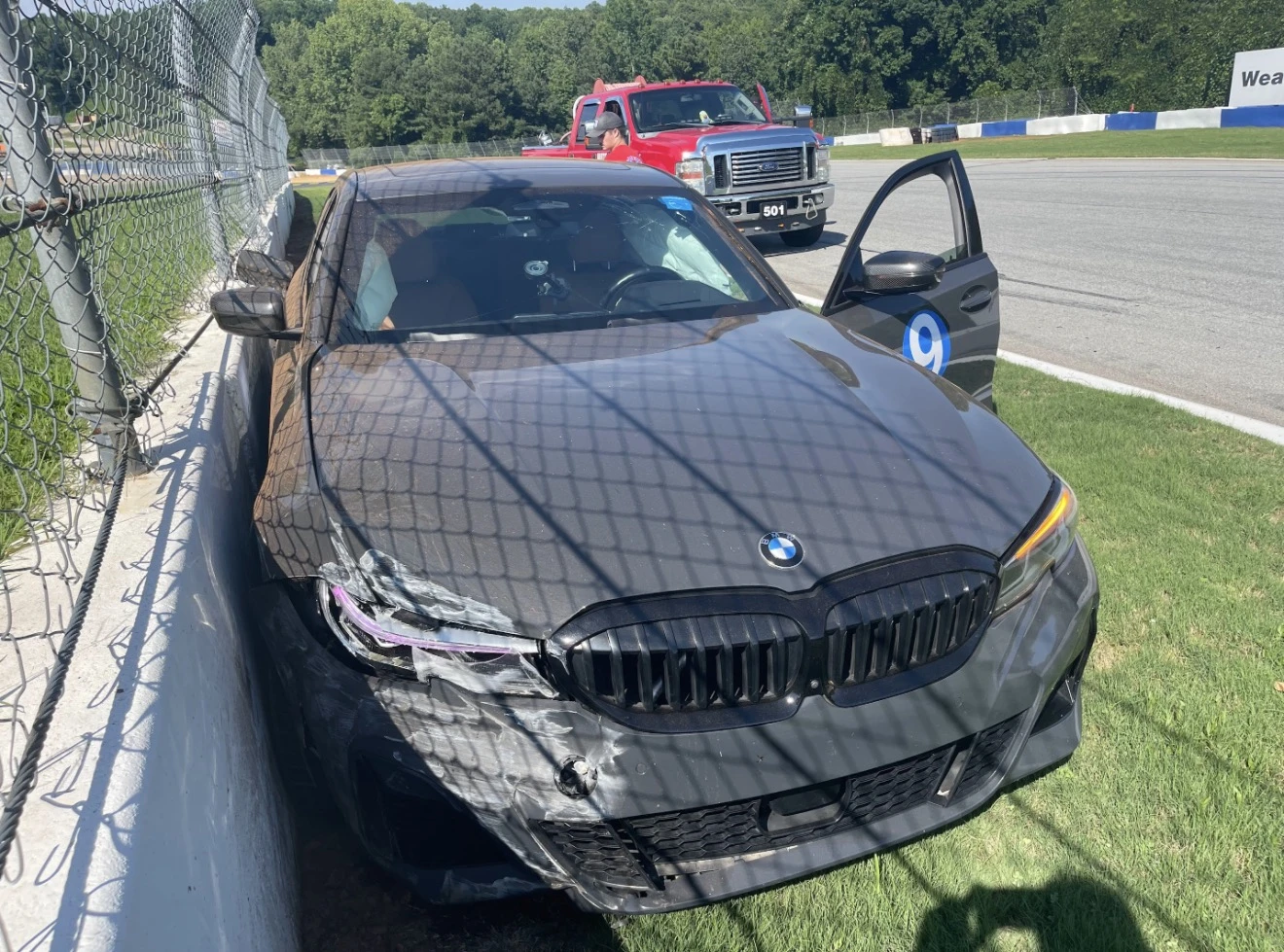 July 16, 2022. The M340i's 36th day on track, my 50th — and its last.
The car was my M340i — my 2019–2022 track car, the one whose Barber history made a cameo in the Barber post. July 16th, 2022, last session of a long day. It was the car's 36th track day and my 50th, I'd reached my peak at Road Atlanta in it, and I'd signed up for coaching that very day to find the next increment of speed. The coaching session was excellent. The very next session, I crashed.
That irony haunted me for three years — take a coach's advice to go faster, immediately put the car in the wall — and it's why, when Levi and Rich both said I wasn't carrying enough speed into T1 now, I didn't just want another opinion. I had the AI reread the 2022 crash telemetry and find out what actually happened.
It found something I didn't expect: the crash wasn't an entry-speed error at all. The trace shows a controlled brake down to 77 mph, a clean 81 mph apex at 1.01g, right on line — and then the rear end let go on exit, past the apex, getting back to power, as the car's heading rotated from 194° to 270° over about three seconds. It was a rear-tire grip failure. I'd started that day the way a lot of street-car drivers would: brand-new rubber on the front — those are the tires taking all the punishment, right? — over rears carrying 15 heat cycles. By that last session the rears were cooked, and a rear-wheel-drive car was asking its worn end to do cornering and power-down at once while the fresh front end gave the nose full bite. Classic RWD exit oversteer. Not the coaching. Not the entry speed. The tires — or really, the mismatch.
If you run 200-treadwear tires, hear this one: don't stagger your rubber's age front-to-rear. "I corded a front and the rears still have tread, I'll just buy two fronts" is exactly the trap. Fresh fronts over tired rears turns your car into an oversteer machine precisely when you're driving your best.
That's a real reframe, and it changed two things. First, my head in T1: the caution I'd carried for three years was guarding against a cause that wasn't the cause. My current T1 — controlled entry, no mid-corner lift, 76 mph and 1.12g through the apex — is already grip-limited on today's tires, and the room is on entry, on fresh rubber, trusting the compression grip. The thing to keep respecting is the exit, where I've apparently already learned the lesson without knowing it.
Second, my garage: it's why I now track heat cycles for every tire I own, in a database, and never run fresh rubber on the front unless the rears are just as fresh. That habit was born in this wall.
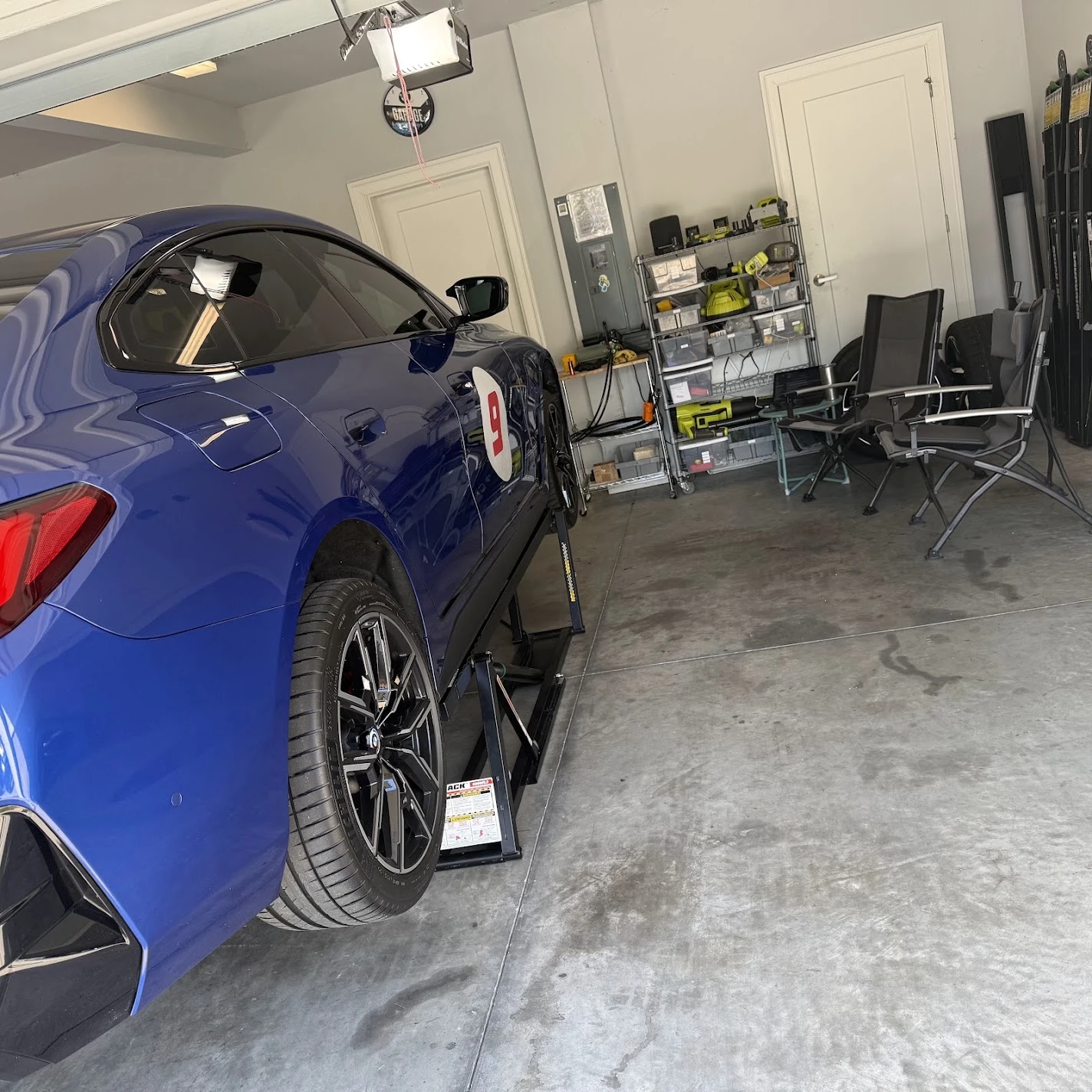 Where the heat-cycle ledger meets the physical world.
And here's the bookend that makes it a lesson instead of a scar. By the end of this June weekend, the P Zero Corsas were heat-cycled out — big time. Levi and I could both feel it from our seats, and the database agreed. But this time all four corners were equally worn, so the balance was safe — just slow. So instead of chasing another PB on cooked tires, the post-coaching session became line work and braking points, banking technique for fresh rubber later. In 2022 I didn't know to make that call. In 2026 it was obvious. That's the whole arc, right there. (It really was the end for that set — the P Zeros retired after this weekend, and a brand-new set of RE-71RZs went on before VIR. Remember that; it matters in parts 3 and 4.)
Levi's T5, and the tip that kept paying
The third corner on Levi's list was T5, and his fix was wonderfully specific. I'd been braking early — just before or right at the rumble strips on the right side of the entry. His instruction: if it will hold, brake as far after those strips as possible. Even on the cooked Corsas I got to practice it that afternoon, and it worked — the line-work session was exactly where that rep belonged.
I can't show you that afternoon in a trace, for a dumb reason and a dumber one: the afternoon export sat undelivered for four days behind an iOS Mail attachment-size ceiling, and when it did arrive, those sessions had recorded without GPS — laps and times, no map. The proof showed up five weeks later instead, back at this same track, in two different cars: T5 braking moved so far past those rumble strips that in one of them the brake event effectively disappeared. That story — and the numbers behind it — is Two Z4s, One AI Race Engineer.
The part I like best: I was at Road Atlanta that July weekend as an instructor, and I passed Levi's exact T5 tip down to my own student — brake later, well past the strips, if it holds. The chief instructor coached the junior instructor into being faster and a better coach. That's the human half of the loop doing something no telemetry ever will.
What a tie is actually good for
A new PB tells you the ceiling moved. A tied PB, driven a completely different way, tells you where the ceiling actually is — and an hour after the tie, the 1:43.50 proved the point. Even that number leaves T12 braking and a clean run to the 130 cap sitting untouched, on top of an Esses improvement that was worth most of a second by itself. 1:43.50 isn't a ceiling. It's a floor with two open items on it.
Barber was two coaches converging on the same diagnosis. Road Atlanta was the follow-up visit: the coach names three corners from the passenger seat, the data grades each one, and the grade sheet says "I learned the lesson" and "I applied the lesson" are two different claims — only one of which shows up in a lap-time app.
Next up
Three weeks later I took the same M440i to VIR — no coach in the car, no coach on pit lane, just me and the AI half of the loop, at a track where the 130-mph-capped family hauler had no business setting personal bests. The heavier, slower car went faster than the light one. That's the VIR post.
And the July return to Road Atlanta I promised in that weekend's Facebook post — "hopefully in the manual E86 Z4 Coupe, where someone can teach me to heel-toe, I think I'll need a human coach for that" — happened. That story is in Two Z4s, One AI Race Engineer — about what a $12 brake part did to that plan.
Correction, September 2026: I originally wrote the heading swung around in about half a second. The data shows about three seconds.