The Heavier Car Went Faster: VIR, No Coach, and the Weekend the Loop Flew Solo
Jun 28, 2026
The Heavier Car Went Faster
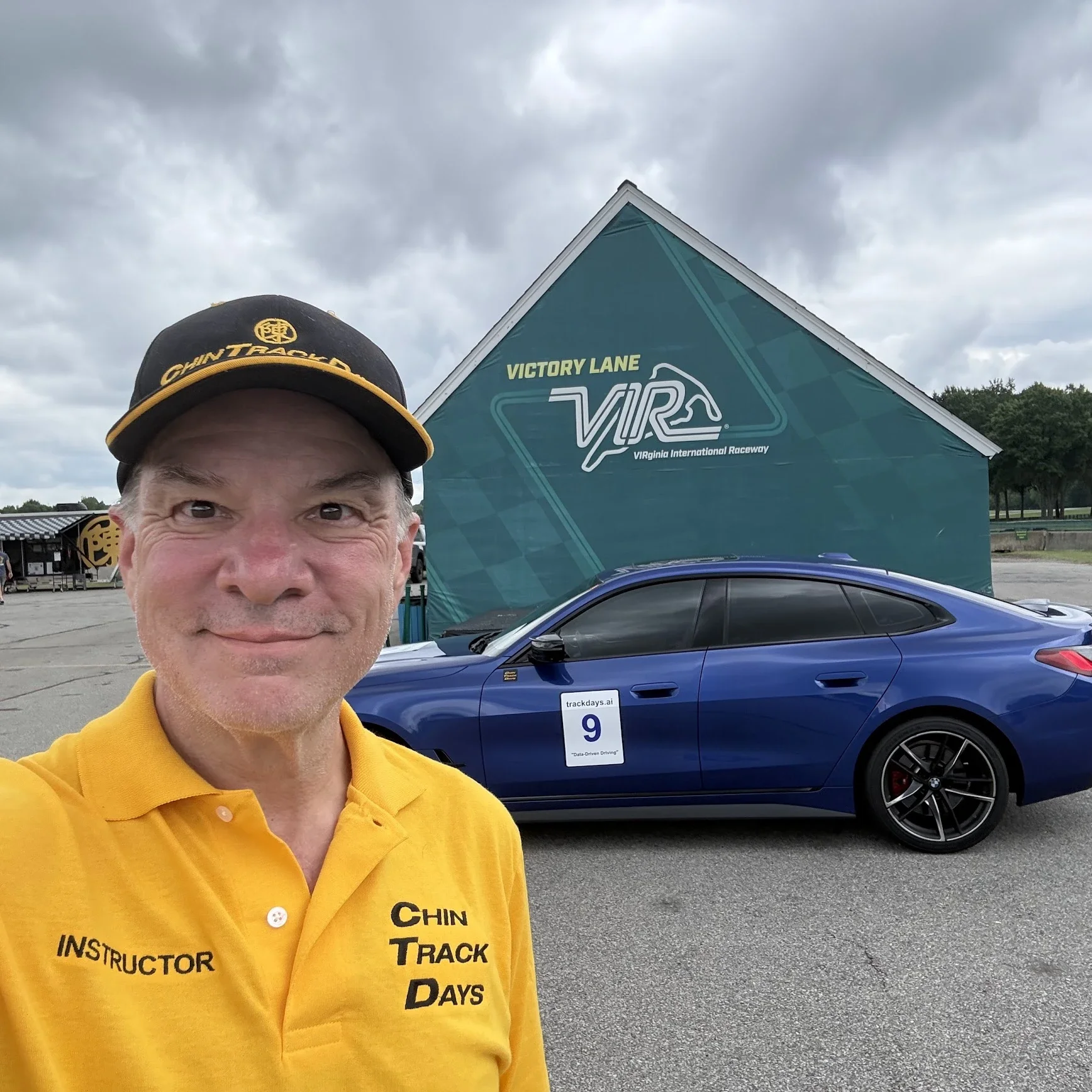 Victory Lane, VIR. The number 9 came along; so did the instructor shirt.
AI-coached track weekends · VIR, June 2026. The Barber post and the Road Atlanta post each had a human coach in the loop. This weekend didn't — which made it the real test.
Three weeks after Road Atlanta, I took the M440i to VIR with Chin Track Days. I was there as an instructor — coaching other people's laps all weekend — which means that for my laps, there was no coach in the car and no coach on pit lane. Just me, the AI, and a lot of data between sessions.
That's worth pausing on, because the first two posts in this series weren't that. At Barber, the AI flagged the same three corners Rich would go on to demo in person, and the two converged independently in the same afternoon. At Road Atlanta, Levi rode along and gave me three specific things to fix, and the data afterward showed I'd only really fixed one of them. Both of those weekends had a person in the loop, watching me drive.
VIR didn't. VIR was the loop running on its own: upload laps, get a conversation about where I wasn't committing, go back out, repeat. If that loop was going to hold up anywhere, it had to hold up here, because there was no one else to catch what it missed. (To be clear about what this weekend does and doesn't prove: the Barber post's argument stands. The corners the AI flags are exactly where I'd spend a coach's time if I had one — the loop alone is the floor, not the ceiling.)
The car that had no business being fast
The M440i is not a lightweight. It's a heavy coupe running a 130 mph speed cap for the weekend, on RE-71RZ 275s square across a 19x10 setup — good tires, but not a substitute for the horsepower a capped car doesn't get to use down VIR's long back straight. On paper, this is not the car that sets a personal best at a track with as much full-throttle time as VIR has.
What made the weekend useful wasn't the car — it was that the AI had my whole history at this track to diff against. Not a feeling about whether I was "leaving time out there," but an actual comparison, car by car:
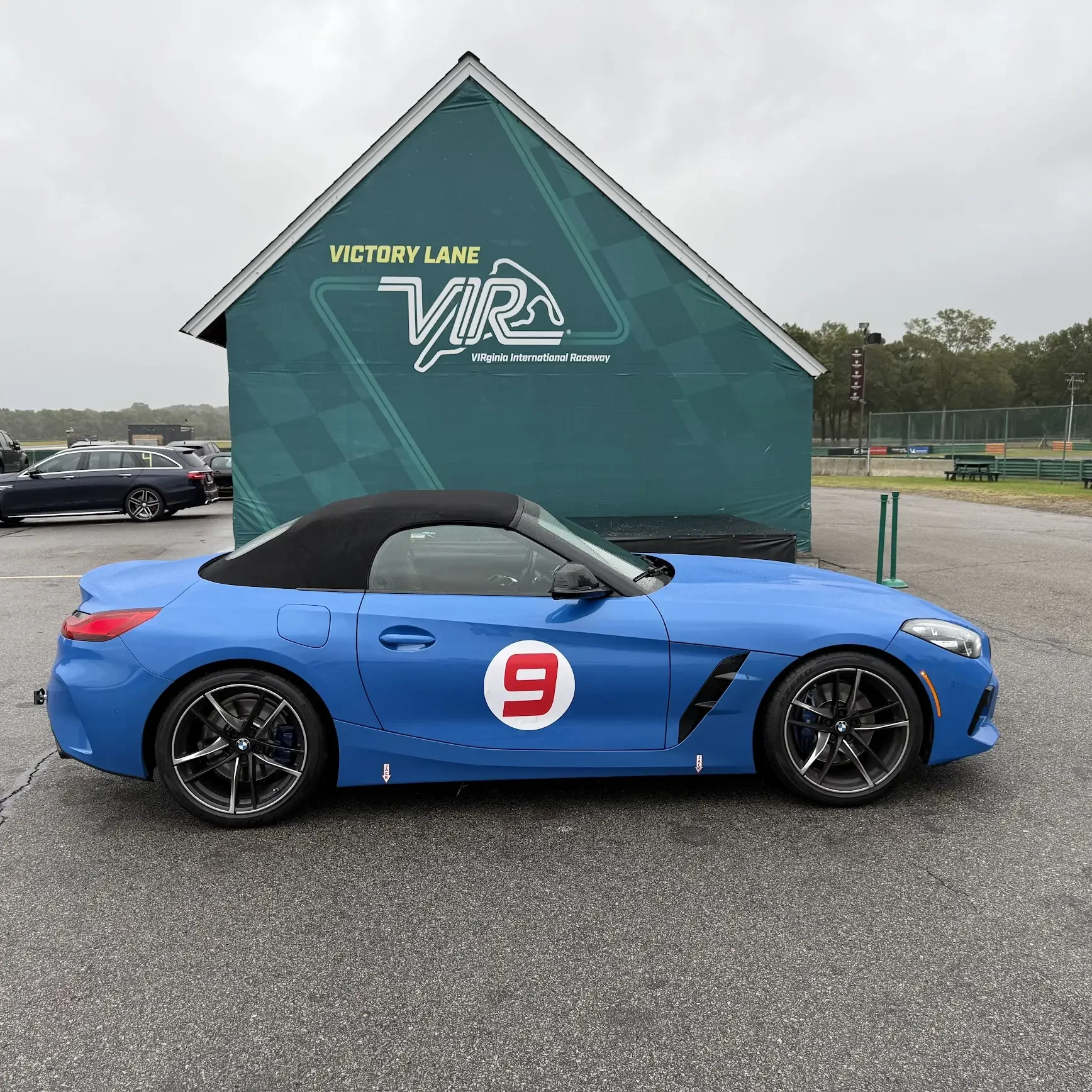 The Z4 M40i's one and only VIR outing, last October: 2:16.61.
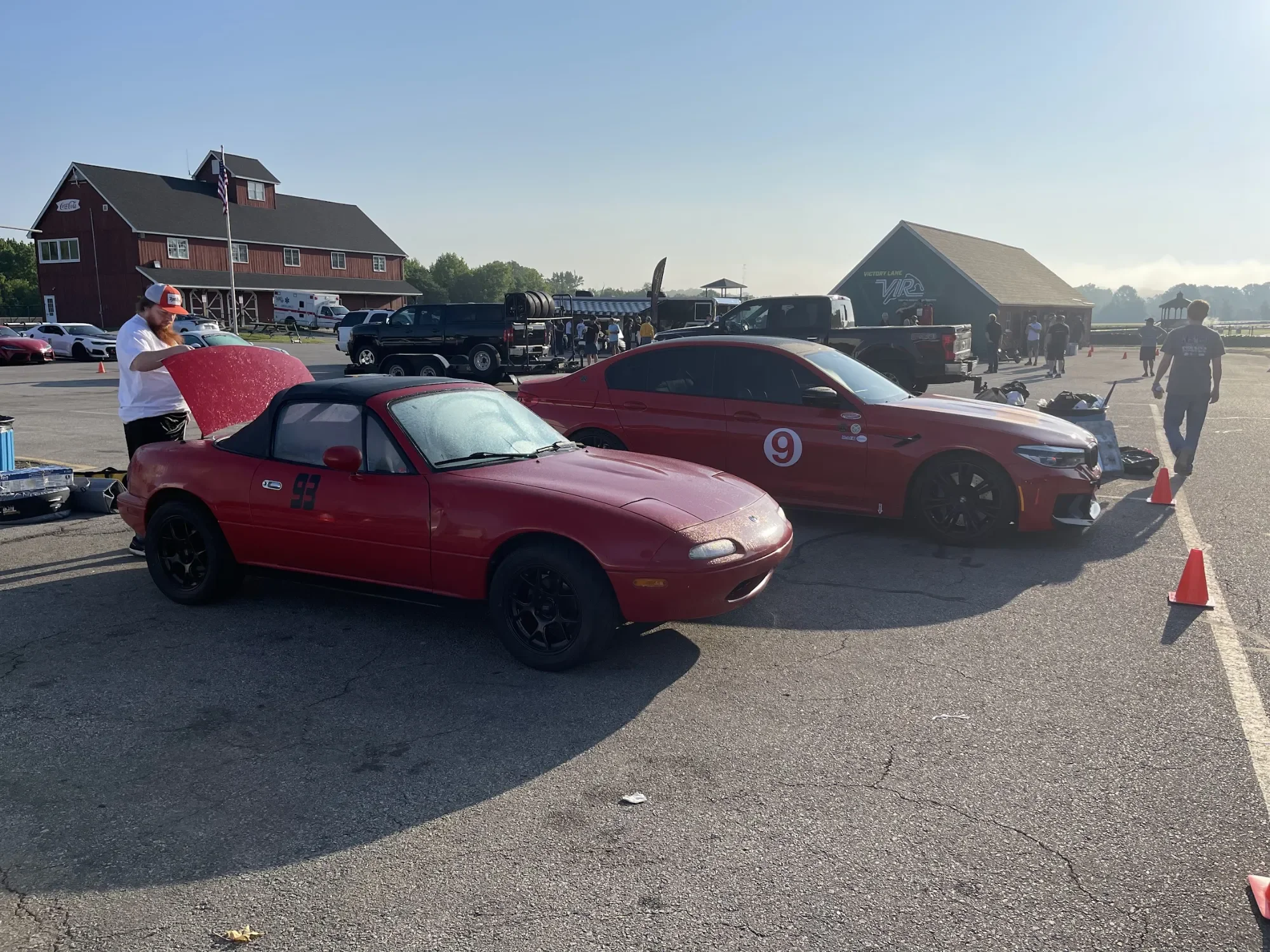 The M5, June 2023 — still my all-time VIR benchmark at 2:12.92. Same number 9,
back when it was a magnet.
The M5, June 2023 — still my all-time VIR benchmark at 2:12.92. Same number 9,
back when it was a magnet.
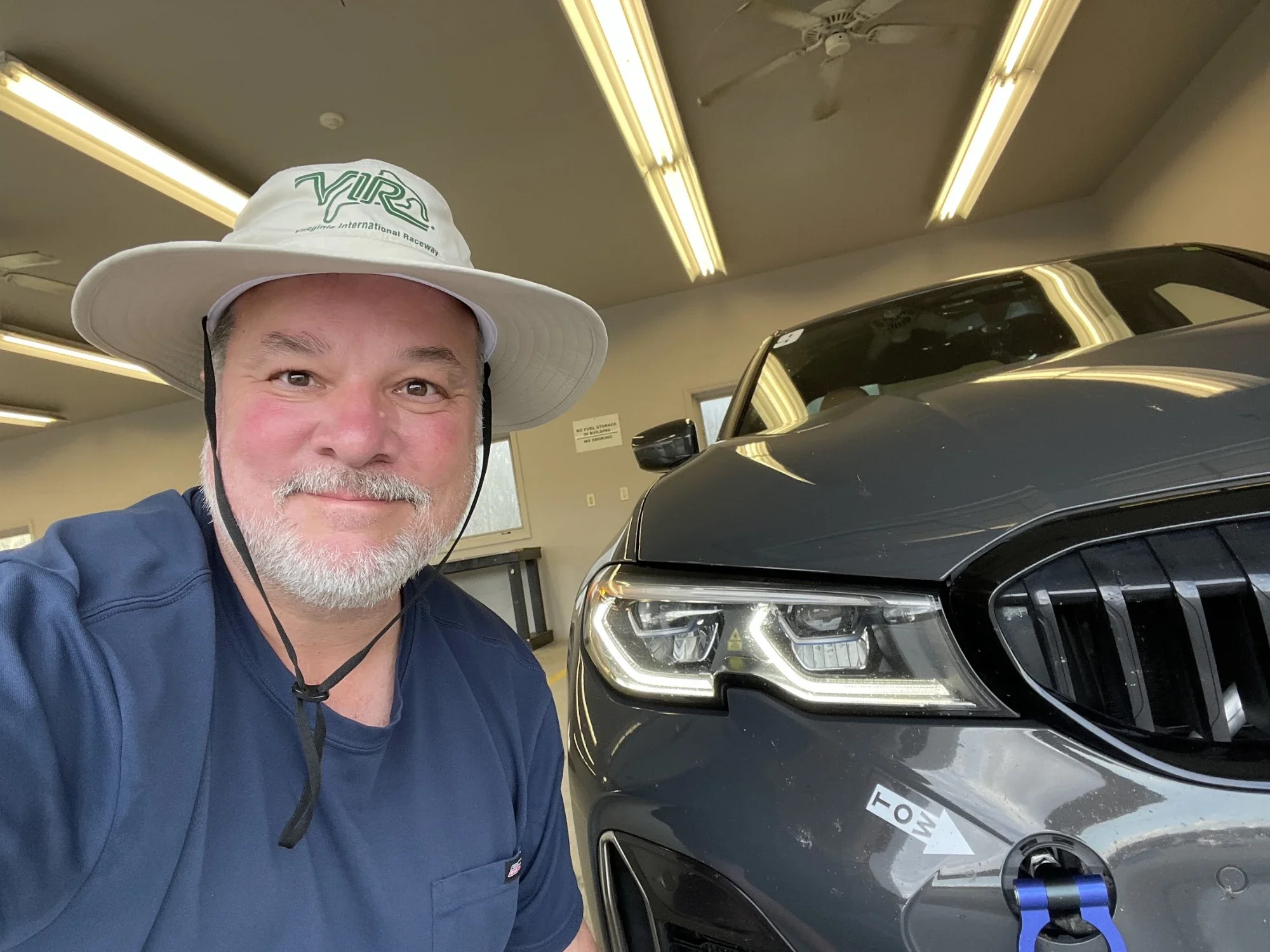 And the M340i, March 2022 — the deepest layer of the VIR history.
This M440i lap against the Z4 M40i's best from last October, against the old M340i's 2022 data, against my all-time M5 number from June 2023. Three different cars, three different setups, one lap trace to overlay them on. That's the kind of comparison that's tedious to do by hand between sessions and trivial to do when the data's already ingested and waiting.
Sunday's best was 2:14.12 — clean, 31 valid laps on the day, nothing dramatic. The AI ran the numbers overnight and came back with two things. First, a theoretical-best calculation stitched from my fastest mini-sector times so far: 2:13.00. Not a fantasy lap — a lap built entirely out of sectors I'd already driven, just not all in the same 15 minutes. Second, a per-corner grip comparison against the Z4's own VIR data: by its count, the M440i was out-gripping the Z4 at eleven of the thirteen corners it measured. The RE-71RZ tire thesis was holding. And at one corner, it wasn't holding at all.
The uphill Esses: 0.87g and a lot of unused grip
Every real corner on Sunday's best lap was pulling somewhere between 0.95 and 1.22 lateral g except one section. The climbing Esses — that snaking uphill stretch that asks you to commit through a direction change without really seeing the exit — never got above 0.87g, and most of it sat in the 0.6s. The throttle trace through the section told the story better than the g-number did: about 30% average throttle across the Esses, against corners elsewhere on the same lap where I was back to full commitment without a second thought.
This wasn't a grip problem. The tire had roughly a quarter of a g still on the table. It was a commitment problem, and in a car that's given up its power advantage to a speed cap, the Esses is exactly where you can't afford to leave momentum on the table — you can't buy it back on the straight the way a faster car can.
The fix the AI landed on was almost embarrassingly simple to say out loud: two breaths, not fifty. Stop feathering the throttle continuously through the whole 500 meters of the section. Take two deliberate breaths at the direction change, and between them, commit to everything — trust the tire, hold the line, stay off the curbs except the one that's meant to be cut. It wasn't a new skill. It was permission to stop hedging.
I ran it Monday. By 11 AM I'd already banked a 2:13.40, and the day ended with a 2:13.14 — a lap that beat the theoretical-best calculation from the night before, because "theoretical best" only knew about the sectors I'd already banked, and the Esses fix opened up a sector I hadn't banked yet. The trace agrees on where the time came from: the Esses complex peaked at 1.05g on the PB lap, up from Sunday's 0.87, with throttle commitment up by half.
The 2:13.14, onboard — lap 38 of 41, Monday afternoon.What 2:13.14 actually means
Line the number up against the rest of the arc and it gets more interesting. Last October, in the lighter Z4 M40i — less weight, no speed cap, a car that should be better suited to VIR's long straights — my best at this track was 2:16.61. The M440i, heavier and artificially slowed, beat it by 3.47 seconds. And measured against my all-time VIR number in the M5 from June 2023, a car with a genuinely different power-to-weight relationship, the M440i came within 0.22 seconds. On corner performance alone the heavier car was closing a gap the spec sheet said shouldn't close.
None of that happens without the comparison being available in the first place — the Z4 number, the M5 number, the theoretical-best sector math, all sitting there to check a lap against instead of trusting a stopwatch and a gut feeling about "that felt quick." The loop wasn't coaching me to drive like someone else. It was showing me where my own data said I already had the answer and just wasn't using it.
The database doesn't care about my Facebook posts
Monday morning, between sessions, I posted to Facebook: having a great time, "2:14.16 yesterday," down to a 2:13.40 with the Esses fix, might be a 2:12 out here if I can stay flat through the Esses.
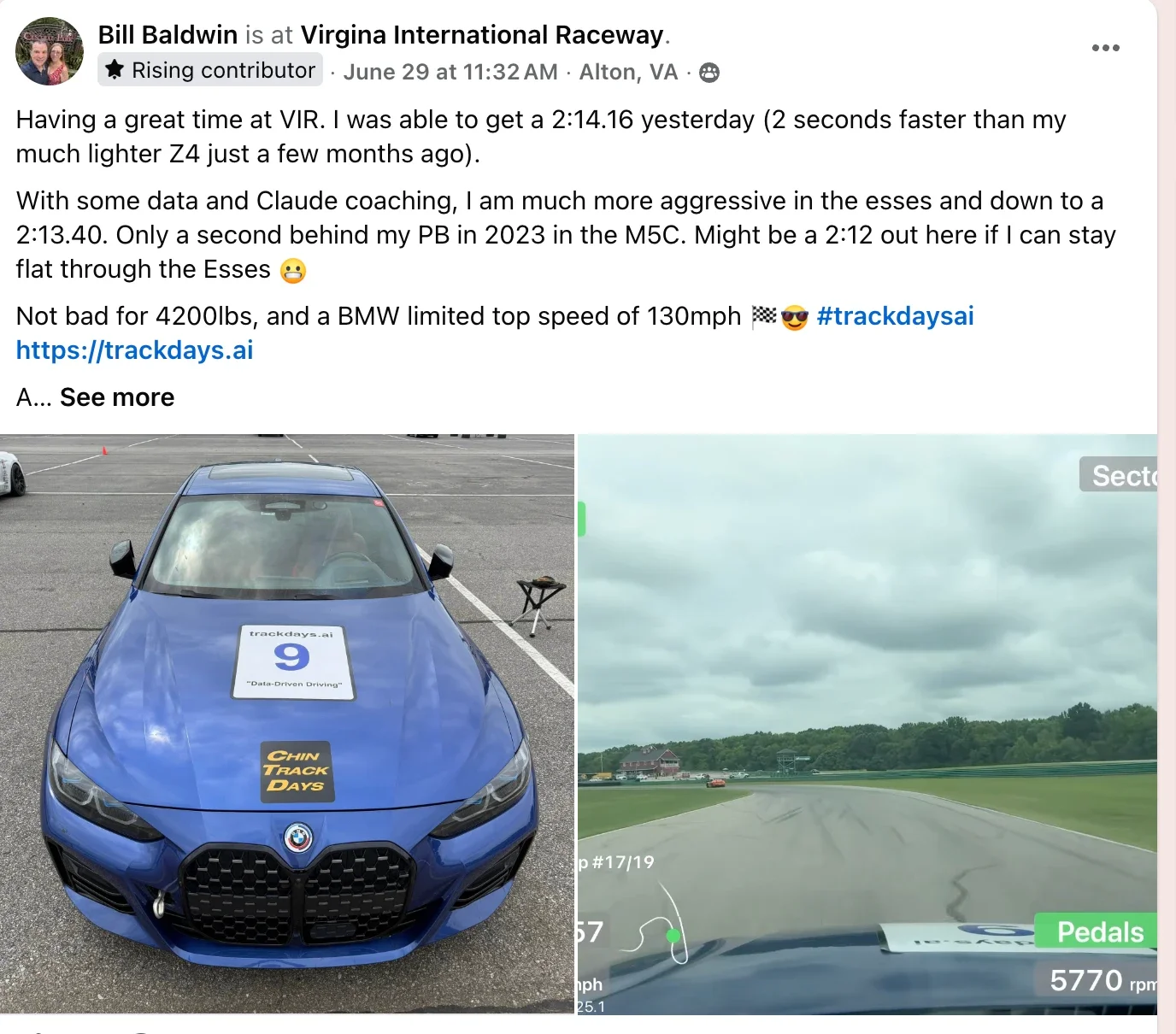 Posted 11:32 AM. The 2:13.40 had happened 25 minutes earlier, on lap 17.
While writing this post, the database corrected me — again. Sunday's best wasn't a 2:14.16; it was a 2:14.12. Third post in this series, third time my memory of my own lap times was off by a hair and the data quietly fixed it. (The Barber post: wrong day. The Road Atlanta post: wrong units. I'm sensing a theme, and the theme is why trackdays.ai exists.)
The 2:12 prediction stands, though. I'll take that bet on fresh rubber.
The other thing a coach does
There's one more story from Monday, and it's the one that convinced me the solo loop is more than a lap-time machine.
Late in the day, I was chasing a Porsche Cayman GT4 down the straight into Turn 13. I'd been wanting a point-by for a lap and hadn't gotten one, I was a little frustrated, and I was focused on his bumper. Then everything ahead of us checked up, and it felt — at 125+ mph — like I got brake-checked into T13. I came off track with the red mist still up, pretty sure I'd just been wronged.
So I asked the AI to find the moment and pull the video.
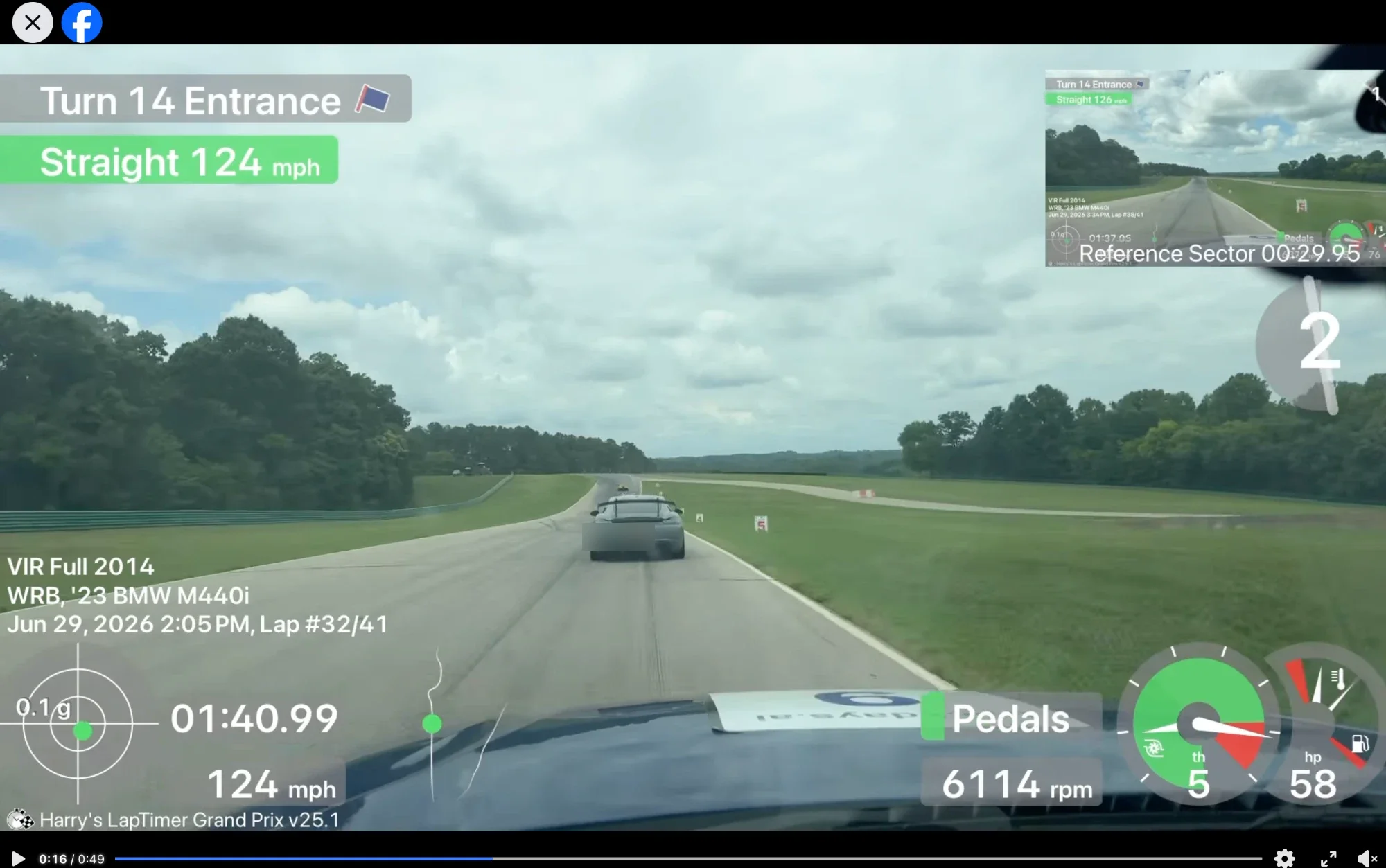 Lap 32 of 41, 2:05 PM Monday. Onboard, closing on the GT4.
It started by building my normal signature for that braking zone — where I brake, how hard, from what speed to what speed — and then scanned the afternoon's laps against the baseline. Lap 32 lit up instantly: braking 65% harder than normal (-0.94g against my usual -0.57g), starting about 40 meters earlier, and scrubbing roughly 30 mph more than my normal entry. The lap came in at 2:20.42, one of the slowest of the afternoon, because a stop like that kills your whole run through T13 and the Roller Coaster.
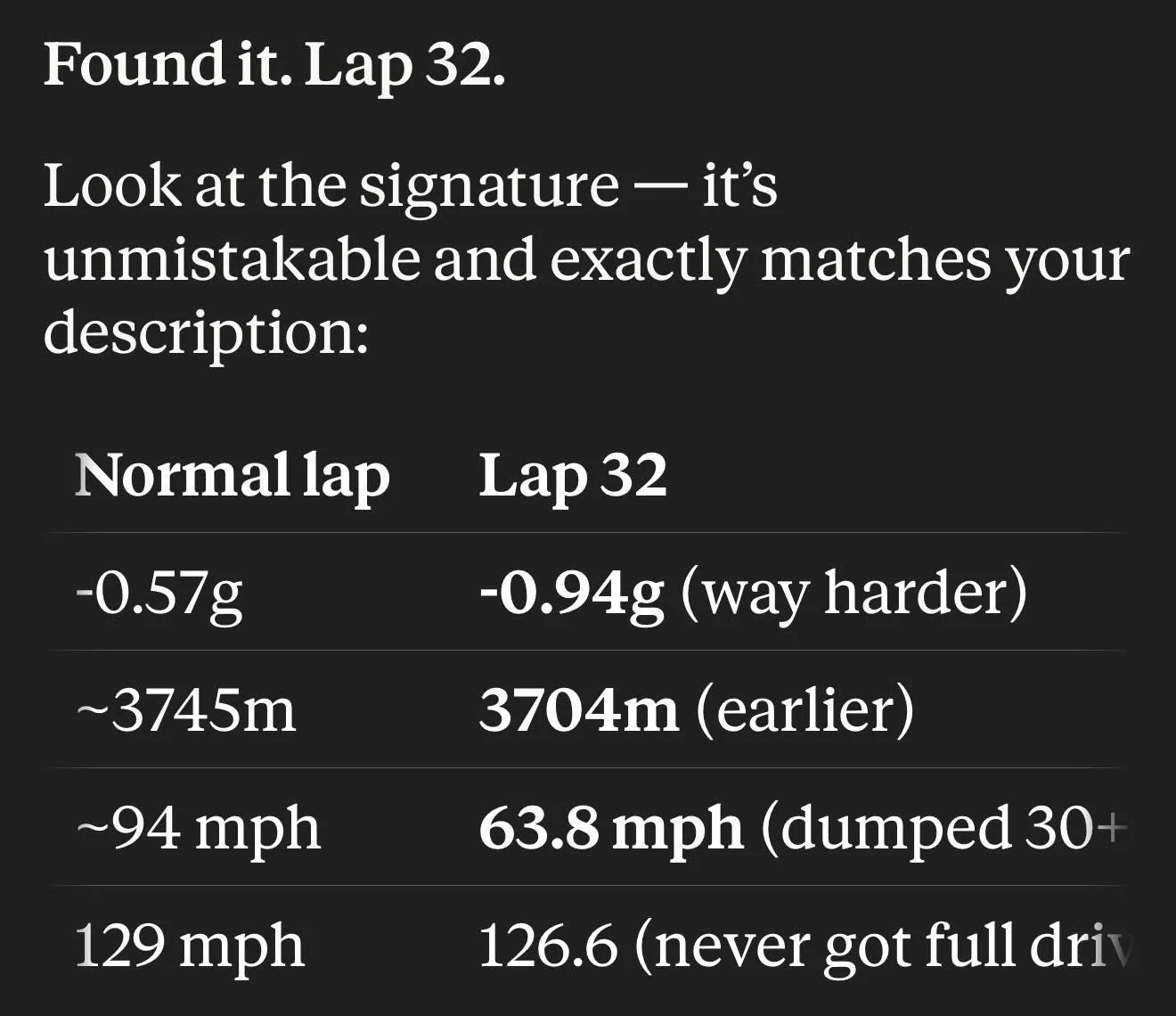 The hunt, mid-conversation: baseline built, lap 32 found, signature matched.
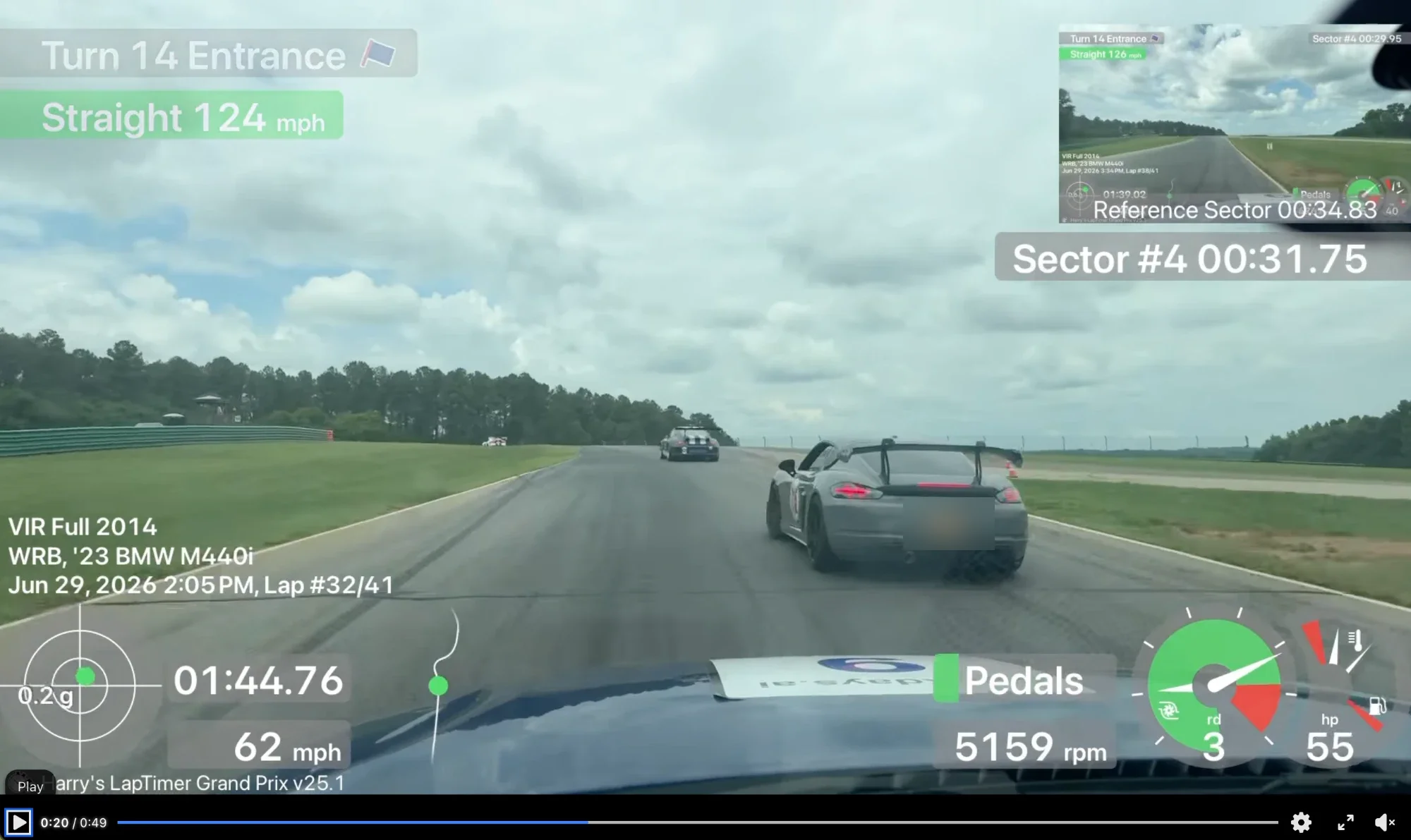 Seconds later: down to 62 mph, the GT4 already gone. Sector 4 nearly two
seconds off my reference.
Seconds later: down to 62 mph, the GT4 already gone. Sector 4 nearly two
seconds off my reference.
Then I watched the video, cued to the exact second. And the video was not on my side. Yes, the Porsche checked up hard in front of me. But the traffic ahead of him was already braking, and he was reacting to it — the information was right there in the windshield, and I'd have seen it if I hadn't spent the whole straight staring at one bumper, stewing about a point-by. The unplanned stop was the consequence, not the crime. This one was on me.
That's the other thing a coach does. The Barber post was about a coach teaching you speed. This is the one where the coach sits you down and makes you watch the tape of the thing you already know, deep down, you did. I went looking for evidence I'd been wronged and found evidence I was the problem — delivered flat, corner by corner, by the same loop that had just found me three seconds. A good lesson learned at 130 mph, and a cheaper one than the 2022 version at Road Atlanta.
Next up
I came home from VIR convinced the loop worked without a coach at the track. I didn't yet know it would get tested by something much dumber than an uphill Esses: a twelve-dollar bleeder valve, snapped clean off in a caliper, seven days before I was due back at Road Atlanta — in a car I hadn't even planned on bringing. That's the next post.
Want your laps analyzed like this? Email your exports — Harry's LapTimer .hlptrl, or CSVs from Porsche PTPA, AiM, RaceBox — to upload@trackdays.ai.