Bill's E86: 2008 Z4 3.0si Coupe
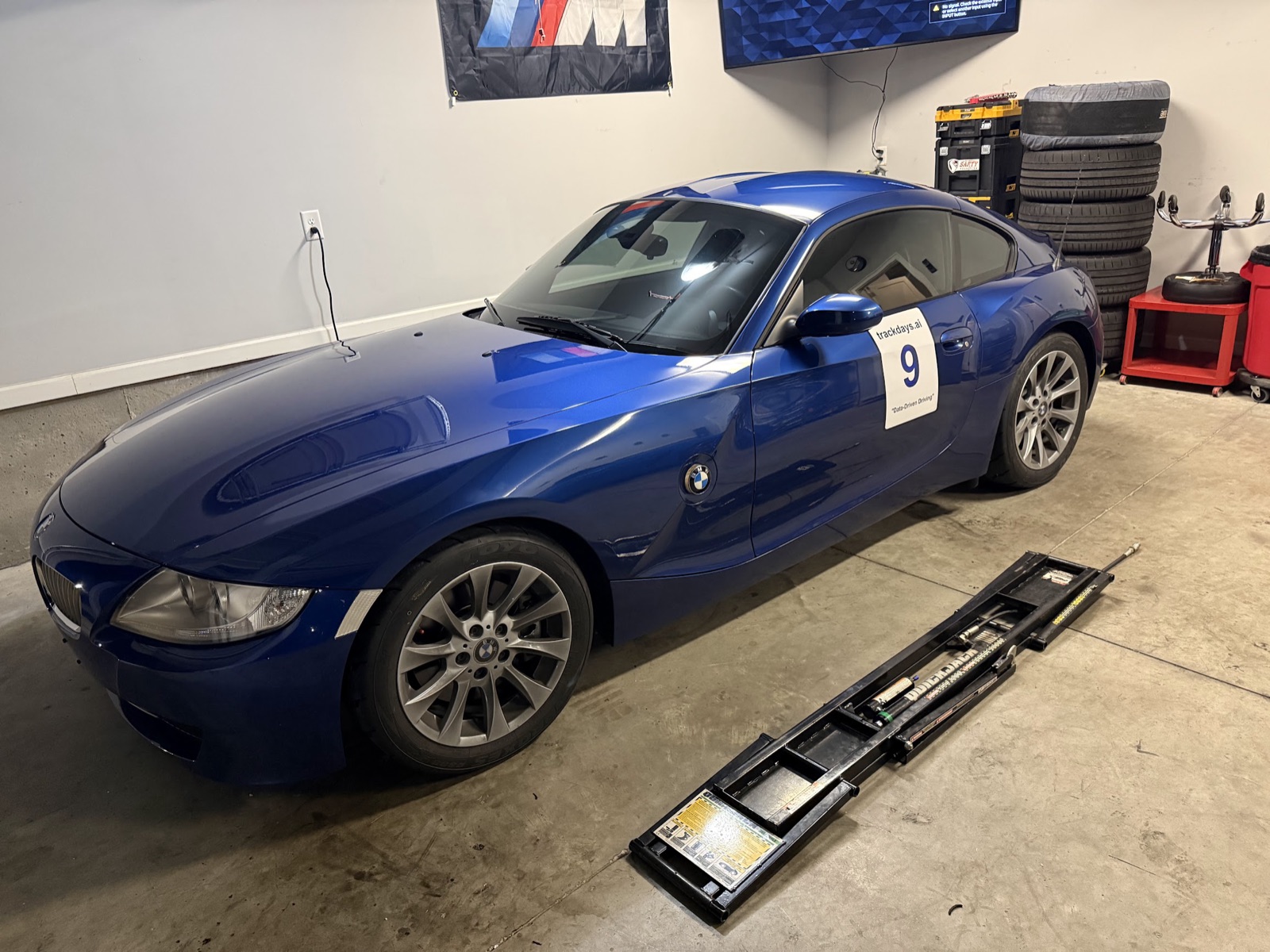 The car as it actually sits today: stock wheels, Toyo rubber, non-Sport suspension, and a door magnet. Everything below is the plan to change that, one measured variable at a time.
The premise of this car is deliberately awkward: build it slowly, and measure every single change. No shopping-list weekend, no five mods at once. One variable at a time, on a chassis where the parts catalog actively misleads you, with every lap logged into trackdays.ai so the deltas are real numbers rather than seat-of-pants impressions.
That makes it a slower build than most. It also makes it the only build I've done where I can tell you what each part was worth.
Where it started
Bone stock, and stock in the least helpful way: non-Sport suspension — original soft springs and dampers, all fresh at around 36,000 miles. What it did have was the ends sorted:
| System | State at debut |
|---|---|
| Tires | Toyo R888R (DOT-R) |
| Brakes | ATE calipers, Zimmermann rotors, Hawk DTC-60 pads |
| Suspension | 100% stock non-Sport |
| Alignment | Factory — understeer-biased by design |
| Seats | Stock |
Real rubber, real brakes, sofa suspension. Which is exactly why dampers and alignment are the largest available gains and why the alignment comes first — see the chassis page for why the entire deficit on this car is front camber.
Current state
The car debuted at Road Atlanta in July 2026 — a weekend where the brakes had been parts in a box five days earlier — and ran its second and third baselines through the back half of the season, still on stock suspension.
Road Atlanta best: 1:48.99 (July 2026).
That lap matters for one reason beyond bragging rights: it's the only baseline this car has at a track it will return to, which makes Road Atlanta the venue where every subsequent change gets measured. Barber and AMP baselines are being banked for the same purpose.
- 🔗 Every logged lap in this car, by track
- 🔗 The car in the garage — setup and service history
- 🔗 All of my laps across every car
The delta that defines the target
The same driver, on the same weekend, at the same track, in a 2022 Z4 M40i (G29): 1:40.53. Against the E86's 1:48.99 that's 8.46 seconds across fourteen years of BMW development.
Aligned meter by meter, only about a third of that gap is the engine. The rest is chassis, rubber, brakes, and driver — which is to say, the rest is a build plan.
- 📖 Fourteen Years, Eight and a Half Seconds: G29 vs E86 at Road Atlanta
- 📖 Two Z4s, One AI Race Engineer
The roadmap, in order
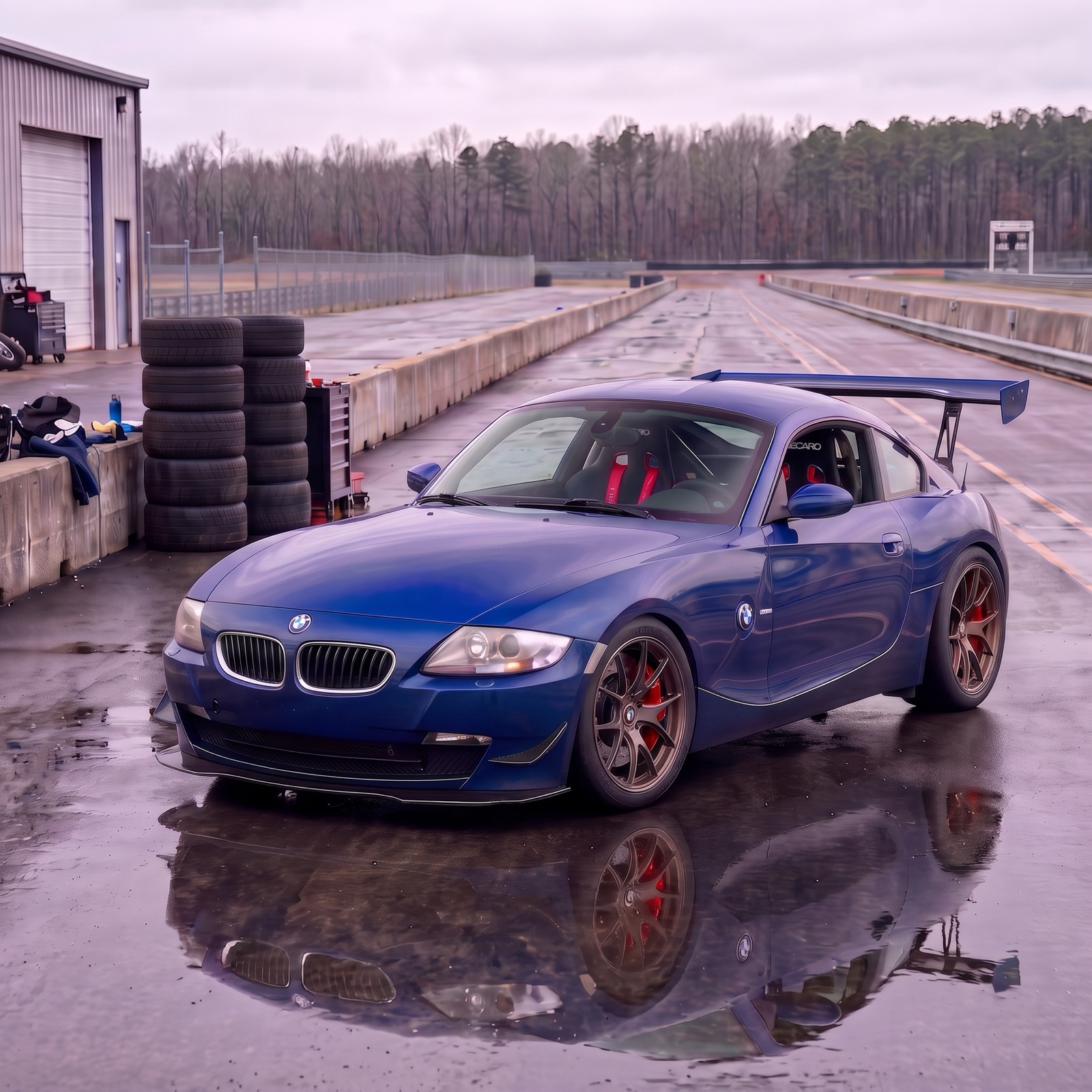 Not a photo — an AI render of the build target, not the car that exists. Wing, splitter and canards, bronze wheels, red calipers, Recaros and a bar. Several of those items are items 2, 3 and 5 on the list below; the aero isn't on the list at all yet.
1. Alignment ✅ the free win
Pull the front camber locating pins → front to ~−1.5°. Reduce rear toe to 4–6 minutes total. Cost: an alignment fee.
Why first: it's free, it fixes a fault the factory built in on purpose, and it stops the R888Rs destroying their outside shoulders. And because there's a July Road Atlanta baseline in the bank, a return visit measures the alignment delta against it — same car, same track, one variable. That is the whole experimental design in one sentence.
2. Seats — before the coilovers 🛒 ordered 21 Aug 2026
This is the counter-intuitive one, and it's the right call.
Ordered: a Recaro Pole Position ABE driver's seat — artificial leather in black with Dinamica red (part 070.77.0886), from maar-shop.com, with an ETA of 28–35 days, so late September 2026. The mounting hardware went on the same order: a Brey-Krause R-9220 driver-side side-mount adapter (E46/E85/E86, large width) and the matching R-9226 slider handle.
Driver consistency is the largest noise source in the entire program — larger than a two-click damper change. Stock seats mean bracing with your arms, which corrupts steering inputs, and it gets worse as the session goes on and you get tired. Fixing the seat removes noise from every experiment that comes after it. Buying dampers first means measuring them through a sloppy driver.
Two more reasons: seats work on day one with no shakedown, and a coilover install needs a corner balance, an alignment, and a session or two just to find its own baseline.
⚠️ The tension worth naming: installing a seat mid-season makes that event's baseline not driver-comparable to the earlier ones. The clean answer is to fit it after the last baseline event, in place for the next Road Atlanta.
⚠️ The sizing is inverted from the obvious. This car gets driven by instructors and other drivers who are larger than I am, so the seat has to be specified for the biggest likely occupant, not for me. That rules out a lot of otherwise obvious choices.
3. Spindles, coilovers and camber plates — winter work
MCS 2WNR — Motion Control Suspension, two-way non-remote: separate compression and rebound adjusters, no remote reservoir. This replaced an earlier pick of the KW Clubsport (35220804). Background on the whole comparison is on the chassis page; the full write-up of the spec — rates, valving, and how it was chosen — follows once the kit is ordered and specced.
M-car spindles, the dampers and the camber plates are one job — one alignment, one corner balance — because splitting them means paying for the same teardown and the same setup work twice. The plates in particular wait for this step rather than going on early: they ride on the coilover's own spring perch, and the stock-spring plate and the coilover plate are not the same part. What comes out of the job is −2.5° to −3° of front camber instead of the factory one degree, which is the grip that pays off in exactly the corners the car gives away speed in today. The KW Clubsport was the other finalist and lost the argument the moment the spindle swap entered the plan — a build-to-order M-spindle application beats a catalog non-M kit once the knuckles are changing anyway, and the spindles quietly unlock the rest of the catalog, brakes included.
The kit is the MCS Z4M 2-Way Non-Remote damper set via BimmerWorld, spec'd — springs, camber plates, the lot — with a BMW race shop that recommended it in the first place. Decided, not yet ordered.
Installed with strut tower reinforcement plates front and rear and new rear shock mounts in the same order, because doing them later means paying to take it apart twice. Corner balance and a race alignment after.
Winter rather than mid-season, so the car arrives at the following spring with a full season to tune rather than burning a good event as a shakedown.
⚠️ This breaks the trailer ramp math — see the ride-height section on the chassis page. The fix is at the ramp end, not the car.
4. Damper tuning program — the following season
One variable per session, A/B/A, judged on segment time. About two real experiments per event → 12–16 solid data points across a season. This is the part the whole build exists to enable, and it needs per-session setup logging (dampers, alignment, tires, cold and hot pressures, fuel, conditions) with a carry-forward and a diff view — otherwise it degrades into notebooks.
5. Gated: harnesses and roll-over structure
Not scheduled, and deliberately so. But if that gate ever opens, the answer is already researched: a Wiechers bolt-in bar with the belt-tube option is the harness anchor and the rollover structure in one ~$1,350, 39-pound, four-hour, fully reversible package. In a factory RAL bronze to match the planned wheels, with cleanly finished trim cutouts. Cut, don't gut.
6. Brakes
Already the strongest system on the car relative to everything else. Revisit once the suspension and driver are no longer the limiting factors — at which point the non-M-compatible 355 mm kit is the option to price against the spindle-swap path.
The rule the whole build runs on
Don't repeat. Vary the car, the tires, the setup, the track — and dial it in across many events rather than chasing a single fast lap. Every change gets a before and an after, at a track where a baseline already exists, with one thing different.
It is a slower way to build a car. It is a much faster way to learn one.